
Seung-Wuk Lee
Biologist Faculty Scientist
Research Interests
In my research group, we are particularly inspired by how nature manages complex interactions at interfaces and self-assembles functional bionanomaterials. Therefore, we use bioengineering approaches to both study and mimic these processes. Specifically, we use genetic engineering techniques to design novel peptides/proteins or virus particles and then use them to create functional nanostructures for regenerative medicine, therapeutics, biosensing and energy generation.
Recent Publications
Related News
Two PBD Scientists Win 2013 R&D 100 Awards
Two Biosciences Area projects won 2013 R&D 100 awards, High-throughput NIMS Screening and the Bacteriophage Power Generator.
Bacteriophage Power Generator: Viruses Generate Electricity
The Bacteriophage Power Generator generates power using harmless viruses that convert mechanical energy into electricity, providing a sustainable, cost-effective, nontoxic energy source capable of powering electronics and microdevices. It is unique in addressing the energy challenge of predominantly battery-driven devices.

Divisions
Environmental Genomics and Systems Biology
- Comparative and Functional Genomics
Secondary Affiliation:
Biological Systems and Engineering
- BioEngineering & BioMedical Sciences
- Biodesign
Research Interests
- Developing high-throughput functional discovery platform for thousands of microbial genes, phage genes and extending it to metagenomic samples
- Discovery of bacteriophage-host interaction determinants, mechanistic insights into antibiotic resistance and phage resistance, and how they impact host fitness
- Approaches for doing designed manipulation of microbial communities
- Engineering of phages, phage particles for diverse applications
- Rational design of phage cocktails with antibiotics for phage therapy applications
- Synthetic genetic parts for phylogenetically distinct and industrially important microbes and rules for their functional composition.
PRESS:
Cataloging Nature’s Hidden Arsenal: Viruses that Infect Bacteria
Mammoth Interviews – Vivek K. Mutalik PhD, Scientist at LBNL and Co-Founder of Felix Biotechnology
How Do You Fight Antibiotic Resistance? Ask a Virus. Q&A with Vivek Mutalik by the Innovative Genomics Institute
Uncovering the Secrets of the Smallest Phages Press release from the Innovative Genomics Institute
Programs & Initiatives
Recent Publications
Related News
Congratulations to Biosciences Area Director’s Award Recipients
Seventeen Biosciences staff members were honored, both individually and as part of a team, in seven different award categories.
Biosciences Researchers Launching Biopreparedness Projects
Two scientists in the Area, Greg Hura and Vivek Mutalik, are heading up research projects that are part of the Department of Energy's Biopreparedness Research Virtual Environment (BRaVE) initiative. Yasuo Yoshikuni, a scientist at the Joint Genome Institute, is part of a third project that is being led by Brookhaven National Laboratory. These projects will leverage bioimaging expertise to develop better therapies and vaccines for viruses, develop a high-throughput platform to rapidly design countermeasures to drug-resistant pathogens, and unlock the molecular basis of plant-pathogen interactions to create resilient bioenergy crops.

Research Interests
Our current research focuses on the development of next-generation microscopy and spectroscopy tools to address pressing questions in cell biology. We developed a new method to enable electron microscopy, and correlated super-resolution microscopy, of fully hydrated animal cells by employing graphene, a single-atom-thick carbon meshwork, as the thinnest possible impermeable and conductive membrane to protect cells from vacuum. We also recently introduced and realized the new concept of spectrally resolved, “true-color” super-resolution microscopy, in which we synchronously obtain the fluorescence spectra and positions of millions of single molecules in densely labeled cell samples in minutes. Based on this approach, we have demonstrated in our work high-quality multicolor 3D super-resolution microscopy for 4 dyes only 10 nm separated in emission wavelength.
Recent Publications
Related News
Ke Xu Receives NIH New Innovator Award
Ke Xu, a faculty scientist in Molecular Biophysics and Integrated Bioimaging, has been awarded a NIH Director’s New Innovator Award as part of the National Institutes of Health's High-Risk, High-Reward Research program. Supported by the NIH Common Fund, these grants catalyze exceptionally innovative biomedical research with transformative potential from early career investigators who have never received an NIH grant before. An assistant professor of chemistry at UC Berkeley, Xu develops new physical and chemical tools to explore biological, chemical, and materials systems at the nanoscale with extraordinary resolution and sensitivity. He takes a multidimensional approach that integrates advanced microscopy, spectroscopy, cell biology, and nanotechnology. Xu is among 89 New Innovator Award recipients for 2018. Each grant comes with $1.5 million in direct funds for five years. Read more from UC Berkeley News.
Super-Resolution Microscopy Reveals Fine Detail of Cellular Mesh
Ke Xu, faculty scientist in the Molecular Biophysics and Integrated Bioimaging Division, used super-resolution microscopy to reveal the geodesic mesh supporting red blood cells, enabling them to be sturdy yet flexible enough to squeeze through narrow capillaries as they carry oxygen to tissues. The discovery could help uncover how malaria parasites hijack this mesh and destroy red blood cells. Read more at UC Berkeley News.
The Strings That Bind Us: Cytofilaments Connect Cell Nucleus to Extracellular Microenvironment
New images of structural fibers inside a cell appear in a study featured on the cover of the Journal of Cell Science special issue on 3D Cell Biology, published this month. The images, obtained by scientists in the Biosciences Area, show thread-like cytofilaments reaching into and traversing a human breast cell’s chromatin-packed nucleus. 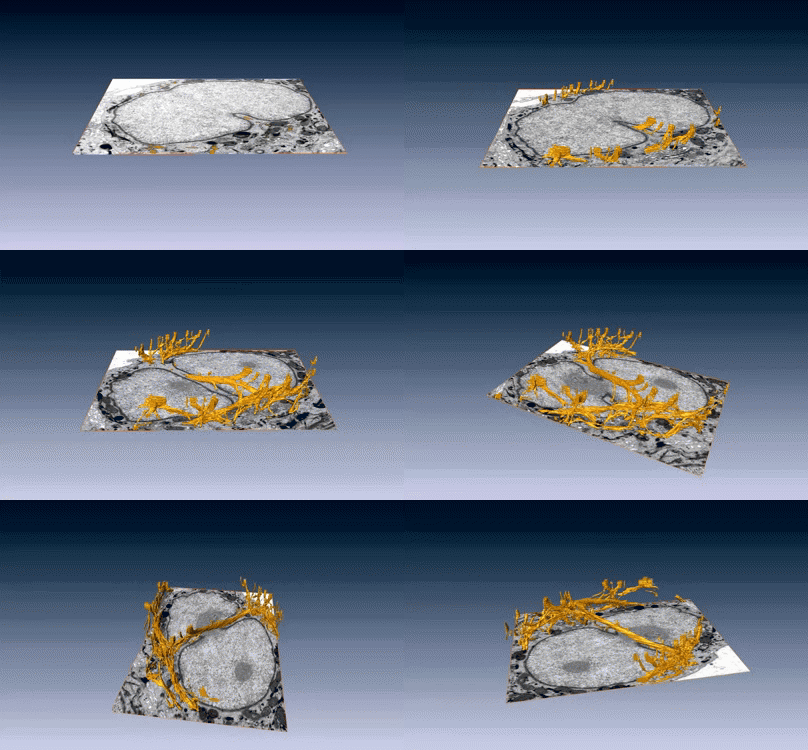 It provides the first visual evidence of a physical link by which genes can receive mechanical cues from its microenvironment.
The work leading up to the images began in the early 1980s when Biological Systems & Engineering's Mina Bissell proposed the idea that gene expression and cell fate were dependent on their physical surroundings called extracellular matrix. The images were captured by Manfred Auer, staff scientist, and Ke Xu, faculty scientist, both in the Molecular Biophysics & Integrated Bioimaging Division. Read more at the Berkeley Lab News Center.
It provides the first visual evidence of a physical link by which genes can receive mechanical cues from its microenvironment.
The work leading up to the images began in the early 1980s when Biological Systems & Engineering's Mina Bissell proposed the idea that gene expression and cell fate were dependent on their physical surroundings called extracellular matrix. The images were captured by Manfred Auer, staff scientist, and Ke Xu, faculty scientist, both in the Molecular Biophysics & Integrated Bioimaging Division. Read more at the Berkeley Lab News Center.
Divisions
Molecular Foundry
Secondary Affiliation:
Molecular Biophysics and Integrated Bioimaging
- Structural Biology
Research Interests
Beamline instrumentation, macromolecular crystallography and X-ray footprinting technique development.
Recent Publications
Related News
Biosciences FY26 LDRD Projects
The Laboratory Directed Research and Development program at Berkeley Lab produces cutting-edge research for the DOE and the nation. Read about the Biosciences Area–led projects and multi-Area collaborations with Biosciences co-investigators receiving funding this cycle.
Towards a New Framework for Radiation Cancer Treatment
Biosciences Area researchers have developed a novel approach for studying the FLASH effect, an emerging frontier in radiation oncology.
Gemini Beamline Banks First Protein Structure
A protein structure obtained at Beamline 2.0.1 (“Gemini”) at the Advanced Light Source (ALS) has recently been published in the literature and deposited into the Protein Data Bank—two significant firsts for this beamline.

Research Interests
Deepti Tanjore is Director of the ABPDU and Head of the Department, Process Engineering and Analytics at Berkeley Lab. She interfaces with several scientists from industry, academia, and start-ups in strategizing and resolving scale-up challenges for their synthetic biology-based technologies. Her research focuses on developing self-driving bioreactor capabilities by modeling the impact of bioprocess conditions on microbial heterogeneity and developing in-line analytical tools for real-time adaptation of process development. She has a PhD from Penn State University in Biological Engineering, BTech from Andhra University in Chemical Engineering, and an MBA from Haas School of Business.
Recent Publications
Related News
Accelerating Science with Digital Twins
Researchers at ABPDU are developing a biological digital twin to model the scaled production of lipids for jet fuel from engineered microbes.
Science Power-up: Where Biomanufacturing Can Take Us This Century
Scientists at the ABPDU are perfecting the science of scale up — transforming biological breakthroughs into commercial products for use in our everyday lives, and growing an industry that can help secure our supply chain and create generational jobs.
The ABPDU: A Catalyst for the U.S. Biomanufacturing Sector
The ABPDU helps biomanufacturing companies scale up innovative biotechnologies and transition them to the marketplace.

Research Interests
My research group at the Joint BioEnergy Institute is focusing on identifying potential drop-in biofuels and building and optimizing the metabolic pathway to produce these target fuels in microbes. Our major target fuels are isoprenoid-based compounds that can be alternative to gasoline, jet, and diesel fuels. To improve fuel production titer and yield, we study the producing host and fuel biosynthetic pathway intensively using various advanced analytical tools such as targeted proteomics, metabolomics, and transcriptomics; and engineer the metabolic pathway in the producing host using synthetic biology tools.
Recent Publications
No publications are available at this time.
Related News
AI, Automation, and Biosensors Speed the Path to Synthetic Jet Fuel
Two breakthrough strategies are rewriting the playbook for designing microbes that make synthetic aviation fuels.
Congratulations to Biosciences Area Director’s Award Recipients
Numerous Biosciences Area personnel are among the 2021 Berkeley Lab Director’s Awards honorees. This annual program recognizes outstanding contributions by employees to all facets of Lab activities. A complete list of winners can be found here. The 10th annual Director’s Awards ceremony will take place on November 18 at noon.
Biosciences Area Projects Receive Technology Commercialization Funding Awards from Department of Energy
Two projects from the Biosciences Area were awarded $1 million from the DOE’s Technology Commercialization Fund (TCF) to further collaborative research with industry partners. The research will enable rapid strain engineering for the production of biofuels and bioproducts from low-cost gas feedstock, and produce a new aviation biofuel precursor from cellulosic biomass.
Building: 978, Room 4128
Mail Stop: 978R4121
Phone: (510) 486-6754
NJHillson@lbl.gov
https://www.jbei.org/person/nathan-hillson/
Links
Research Interests
To develop and demonstrate experimental wetware, software, and laboratory automation devices that facilitate, accelerate, and standardize the engineering of microbes.
Recent Publications
No publications are available at this time.
Related News
Biological Systems and Engineering Division and Program Leadership Changes
Division Director Blake Simmons announced that, effective March 2, Chris Petzold will lead the Biodesign Department as Interim Head following Nathan Hillson’s departure. Petzold will also assume the role of Chief Information Officer for the Joint BioEnergy Institute, as announced by CEO Jay Keasling. Katy Christiansen will serve as the lead principal investigator of the Agile BioFoundry.
Foundational AI Models to Accelerate Biological Discovery
Berkeley Lab is helping build AI models for autonomous research that will enable prediction and precise design of biological systems.
Biosciences FY26 LDRD Projects
The Laboratory Directed Research and Development program at Berkeley Lab produces cutting-edge research for the DOE and the nation. Read about the Biosciences Area–led projects and multi-Area collaborations with Biosciences co-investigators receiving funding this cycle.
Building: 91, Room 439
Mail Stop: 91R0183
Phone: (925) 998-0788
NCKyrpides@lbl.gov
https://jgi.doe.gov/who-we-are/program-platform-leads/groups/microbiome-data-science
Links
Research Interests
Metagenomics, Microbial Genomics, Microbial Diversity, Microbiology, Bioinformatics
Recent Publications
Related News
Taking Stock of the Known and Unknown Microbial Space
In Science Advances, JGI researchers have taken stock of the current state of microbial genomic biodiversity. Using publicly available genome sequence data generated over the past three decades, their study assesses what fraction of the microbial diversity we know about, and proposes a path forward to curate and cultivate what is still unknown.
University of Duisburg-Essen Delegation Explores Collaborative Opportunities with Lawrence Berkeley National Laboratory
Building on a Memorandum of Understanding signed between UDE and Berkeley Lab researchers, a kick-off meeting focused on future collaborations in the fields of genomics, structural biology, bioimaging, and water research.
Doubling Down on Known Protein Families
Through a novel approach detailed in Nature, a massive computational analysis of microbiome datasets by the JGI focuses on unveiling protein functional diversity.

Divisions
Molecular Biophysics and Integrated Bioimaging
- Structural Biology
Secondary Affiliation:
Biological Systems and Engineering
- BioEngineering & BioMedical Sciences
Research Interests
Applied Mathematics
Machine Learning
Scattering
Crystallography
Synchrotron radiation
Free Electron Laser
Recent Publications
Related News
Congratulations to Biosciences Area Director’s Award Recipients
Seventeen Biosciences staff members were honored, both individually and as part of a team, in seven different award categories.
Meet EcoBOT: The Autonomous Lab Standardizing Plant-Microbe Research
Berkeley Lab’s new self-driving laboratory, EcoBOT, automates complex plant experiments to eliminate human error, solve biology’s replication crisis, and accelerate bioenergy research.
Biosciences FY26 LDRD Projects
The Laboratory Directed Research and Development program at Berkeley Lab produces cutting-edge research for the DOE and the nation. Read about the Biosciences Area–led projects and multi-Area collaborations with Biosciences co-investigators receiving funding this cycle.

Building: 978, Room 4122
Mail Stop: 978-4121
Phone: (510) 495-2620
Fax: (510) 495-2630
JDKeasling@lbl.gov
http://keaslinglab.lbl.gov
Links
Biography
One of the foremost authorities on synthetic biology, Jay D. Keasling is Senior Faculty Scientist for Biosciences at the Lawrence Berkeley National Laboratory and the Hubbard Howe, Jr. Distinguished Professor of Biochemical Engineering in the Departments of Chemical and Biomolecular Engineering and of Bioengineering at the University of California, Berkeley. He is the Chief Executive Officer of the Joint BioEnergy Institute and leads a groundbreaking research program focused on engineering microorganisms to produce biofuels, chemicals, and pharmaceuticals.
Research Interests
- Harnessing biology to address diverse critical global challenges in the areas of renewable biomanufacturing, human health, and bioenergy.
- Engineering microbes to produce drugs, chemicals, and fuels.
- Developing foundational tools for engineering metabolism inside cells.
- Creating novel metabolic pathways to produce unnatural molecules.
- Designing robust microbial hosts for producing chemicals under a variety of industrial conditions.
- Applying these methods and tools to important societal problems, such as producing the antimalarial drug artemisinin, a variety of commodity and specialty chemicals, and biofuels.
Recent Publications
Related News
Biological Systems and Engineering Division and Program Leadership Changes
Division Director Blake Simmons announced that, effective March 2, Chris Petzold will lead the Biodesign Department as Interim Head following Nathan Hillson’s departure. Petzold will also assume the role of Chief Information Officer for the Joint BioEnergy Institute, as announced by CEO Jay Keasling. Katy Christiansen will serve as the lead principal investigator of the Agile BioFoundry.
Jay Keasling Named 2025 OTC/NAI Innovator of the Year
Keasling, one of the foremost authorities on synthetic biology, was recognized for being a prolific inventor and entrepreneur.
How Berkeley Lab is Leading the Biology-Based Industrial Revolution
Biosciences Area researchers are playing a key role in shaping the future of biomanufacturing.

Building: 955, Room 512C
Mail Stop: 955-512L
Phone: (510) 495-2116
Fax: (510) 486-6219
aparkin@lbl.gov
http://arkinlab.bio
Links
Biography
At the Lawrence Berkeley National Laboratory, Adam Arkin holds several positions, including senior scientist, Technical Co-Manager of the ENIGMA Scientific Focus Area, and Chief Executive Officer of the Department of Energy Systems Biology Knowledgebase. He is the Dean A. Richard Newton Memorial Professor in UC Berkeley’s Department of Bioengineering, and Director of the Center for Utilization of Biological Engineering in Space. An expert in the comparative systems and synthetic biology of microbes, Arkin is dedicated understanding the role natural and engineered microbes can play in environmental transformation and health as well as sustainable biomanufacturing.
Research Interests
Complex webs of life integrate and drive processes that affect outcomes from the individual health of a human or plant to entire planetary mineral cycles. Our laboratory leverages quantitative measurements, precision genetics, and model-driven experimentation to predict, control, and design biological function in the context of these webs. We are especially interested in understanding and ameliorating the processes that are interlinked with the radical changes our planet is and will be experiencing as climate is forced, populations grow, and pressures are placed on the resources we use to survive. We are also interested in what it might take to establish ourselves on the next planet as humanity begins to consider long term crewed missions on the Moon and Mars. Building safe, sustainable biotechnologies for environmental stewardship, health, food, and materials based on well-informed systems-level bioengineering is our main goal.
We are also committed to open, transparent, reusable and collaboratory model-driven science as exemplified through our work the the DOE Systems Biology Knowledgebase.
Recent Publications
Related News
Foundational AI Models to Accelerate Biological Discovery
Berkeley Lab is helping build AI models for autonomous research that will enable prediction and precise design of biological systems.
Make Mine a Double: Mapping Gene Networks to Decode Function
Scientists develop a pairwise approach to study genomic interactions at scale, revealing vulnerabilities that could be prime targets for new antibiotics.
Revealing the Mysteries Within Microbial Genomes
A new technique developed by Biosciences Area researchers will make it much easier to discover the traits or activities encoded by genes of unknown function in microbes—a key step toward understanding the roles and impact of individual species.
Building: 33, Room 250
Mail Stop: 33R0345
Phone: (510) 486-4225
Fax: (510) 486-5909
PDAdams@lbl.gov
http://cci.lbl.gov/~paul/
Links
Divisions
Molecular Biophysics and Integrated Bioimaging
- Structural Biology
Secondary Affiliation:
Environmental Genomics and Systems Biology
- Comparative and Functional Genomics
Biography
As the ALD for Biosciences, Paul Adams oversees the Biological Systems & Engineering (BSE), Environmental Genomics & Systems Biology (EGSB), and Molecular Biophysics & Integrated Bioimaging (MBIB) Divisions, as well as the DOE Joint Genome Institute (JGI). Adams is a senior scientist who has served as Director of the MBIB Division since 2015 and as Vice President for Technology and Director of Structural Biology for the Joint BioEnergy Institute (JBEI) since 2007. He heads a multi-institutional program, which he established when he joined the Lab in 1999, that develops the Phenix software suite used by structural biologists worldwide to solve macromolecular structures. In addition, he was the Laboratory Research Manager for the ENIGMA Scientific Focus Area from 2009 to 2025 and has overseen the Biosciences activities at the Advanced Light Source (ALS) since 2011. Adams’s research focuses on the development of new algorithms and methods for structural biology, structural studies of large macromolecular machines, and development of cellulosic biofuels. He earned his doctorate in biochemistry at the University of Edinburgh and performed his postdoctoral work at Yale University. He is also an adjunct professor in the department of bioengineering at the University of California Berkeley.
Research Interests
Computational Methods Development
Much of my research is focused on the development of new algorithms and methods for problems in structural biology. In collaboration with researchers from Los Alamos National Lab, Duke University and Cambridge University we have developed a new software system with NIH Program Project funding and industrial funding, called PHENIX, for the automated solution of macromolecular structures using crystallographic and cryo-electron microscopy methods. With other NIH funding we have expanded the scope of PHENIX to include the analysis of neutron diffraction data.
Accelerator Resources for Structural Biology
As Division Deputy for Biosciences at the Advanced Light Source I help coordinate the biosciences activities and lead the Biosciences Council. An area of particular interest to me is the structural study of large macromolecular machines combining multiple experimental and computational methods.
Bioenergy Research
The need to develop carbon-neutral and renewable sources of energy has become a priority. The conversion of cellulosic (plant) material to advanced biofuels has the potential to provide a significant fraction of transportation fuel in the future. As part of the Joint Bioenergy Institute I am developing new technologies to improve the conversion of biomass to fuels. We have also developed new methods for the chemical imaging of plant call wall material.
Recent Publications
Related News
Cracking the Code: Using AI to Solve Difficult-to-map Proteins
Leveraging artificial intelligence and quantum calculations, scientists developed a new tool that yielded higher-quality structural information and solved notoriously elusive proteins.
Foundational AI Models to Accelerate Biological Discovery
Berkeley Lab is helping build AI models for autonomous research that will enable prediction and precise design of biological systems.
IPO Success Story: Phenix Software Accelerates Discovery
Berkeley Lab's IPO has highlighted the many applications and success stories of licensing a Biosciences Area software, Phenix. This tool aims to automate the analysis of structural biology data.


