
For millions of years, nature has evolved to optimize resources and energy. Learning more about how these natural processes work may hold valuable solutions for our future. In the Molecular Biophysics and Integrated Bioimaging (MBIB) Division, teams of researchers are studying the intricacies of photosynthesis to better understand how plants, algae, and some bacteria turn sunlight into chemical energy.
In photosynthetic plants, light initiates a chain reaction in pigment molecules called chlorophyll. The absorbed light energy is used to split water molecules, releasing electrons and protons as well as oxygen into the atmosphere. Eventually, the plant uses the electrons and protons from these light-driven steps and carbon dioxide to construct sugars that it uses for food.
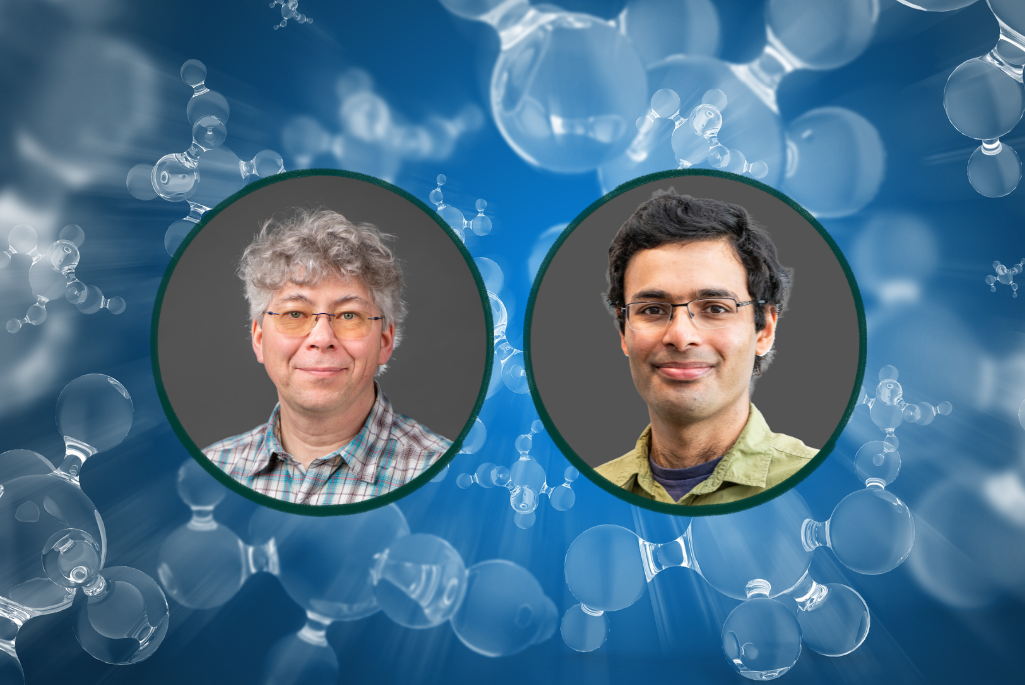
Scientists are still working to understand the precise movement of atoms and the intricate steps they follow. MBIB senior scientist Jan Kern and research scientist Asmit Bhowmick recently published separate papers on different aspects of the photosynthesis process. We caught up with them to discuss the synergies between their work and the importance of collaboration in science.
Biosciences Communications: Tell us about your work.
Jan Kern: My work focuses on the bacterial reaction center (BRC), a group of proteins involved in photosynthesis that has been studied by scientists around the world for decades. In the 1980s, we learned that this protein converts light energy into chemical energy during bacterial photosynthesis. But even though we’ve known what this protein does for about 40 years, we still don’t know specifically what’s going on at a subatomic level. So my team and I have been studying the very specific details of how electrons shuffle and move around in this protein.
Under normal conditions, the electrons formed during the initiation phase of photosynthesis continue down one of two pathways in the BRC. What’s interesting is that there are two paths, but the energy always travels down the same route. We wanted to figure out how to force the electrons to go down the other path, and see what happened.
We collaborated with teams from Argonne National Lab and Washington University in St. Louis. They built a mutated version of this protein where the electrons actually traveled along the typically inactive branch.
At Berkeley Lab, we worked to solve the crystal structure of this protein, revealing the subtle differences of the mutant protein in action. Then we worked with a group at the City University of New York to calculate how the affinity to accept or donate an electron changed for each of these electron transfer co-factors by the changes that we observe in this variant.
Basically, we figured out how to explain why the electron can go the wrong way.
Biosci Comms: This seems like a shining example of collaborative research. How did you and the Berkeley Lab team map out the protein structure?
Kern: My group in MBIB spends a lot of time studying the atomic structures of proteins, which inform the function of many processes here on Earth. Our recent work established a procedure to purify and generate crystals from the mutant protein. We investigated the crystals and based on the diffraction data, built a model of the protein and compared the differences between the normal-functioning BRC and this mutant version.
With our collaborators, we learned that forcing the electrons down the unused path is possible and we know what that ground state structure looks like. Even though I’ve been doing this type of work for years, seeing how something like this works at an atomic level is such a joyful experience.
And this was just the first step. This information can inform future work aimed to help us understand what happens as electrons continue to move down this alternative path.
Biosci Comms: This seems like a great point to introduce Asmit Bhowmick, who also works in MBIB and studies a different aspect of photosynthesis.
Asmit Bhowmick: My work focuses on a different system that’s also involved in photosynthesis, called Photosystem II (PSII). This protein is found in all photosynthesizing plants and cyanobacteria on Earth. It uses light to break apart water molecules, which creates energy for the plant and gives off the oxygen that we breathe. My team and I were interested to understand more specifically how PSII breaks apart water molecules.
This process, also known as the water oxidation reaction, has been well understood for a while. Within PSII, light initiates the conversion of water molecules into energy (in the form of electrons and protons) and oxygen. This reaction occurs deep inside the protein, in a tetra-Manganese cluster called the oxygen evolving complex (OEC). The exact mechanism of how two water molecules come together to form oxygen is of great interest in the scientific community.
In 2018, our group at Berkeley Lab as well as a team from Okayama University in Japan independently showed the binding of an additional water molecule (called OX or O6) to the OEC in the second-to-last step of catalysis, suggesting an important role in the final oxygen formation step. Since then, the existence of this water molecule and its chemical nature has been a heavily debated topic in our field. So, my team and I wanted to really dig in and see if we could actually prove or disprove this intermediary step.
Along with my co-first authors, Hiroki Makita, Philipp Simon, and Miao Zhang, we achieved the clearest data yet that shows that there is, indeed, a new water molecule inserted before the final oxygen-formation step. This extra step rules out certain mechanistic pathways, while solidifying others, and helps inform future research about possible reaction mechanisms.
When we confirmed everything, it was one of those moments when we were all so happy. We spent so much time setting up the experiments, the models, and then monitoring the data, it was gratifying to realize that something like this was happening.
Biosci Comms: Tell us more about how you and the team approached this work, especially given that it’s been a debated topic in your field.
Bhowmick: A lot of work also went into the details of the science behind modeling these kinds of intermediates. For the last five years, there’s been a debate on whether or not this intermediary step even exists. Some people have disputed our and other’s claims based on how the modeling was done. But then there are other disputes about how the extra water molecule interacts with other waters in the surrounding space, based on the modeling procedures. So we kept asking ourselves, how do you actually come up with the evidence for a new water molecule?
We got to a point in our work where we had a lot of data and had to figure out what to do with it, and how to interpret it. With our collaborators at Berkeley Lab, more specifically the Phenix and the DIALS teams, we developed tools to be able to actually process this data appropriately and model it accurately.
Kern: We have a lot of expertise at Berkeley Lab, working across groups here was very important to push both the processing of this data and the modeling of it forward.
Biosci Comms: To look closely at these subatomic particles and reactions, you both utilized the same imaging technology. Tell me more about your approaches and collaboration across your experiments.
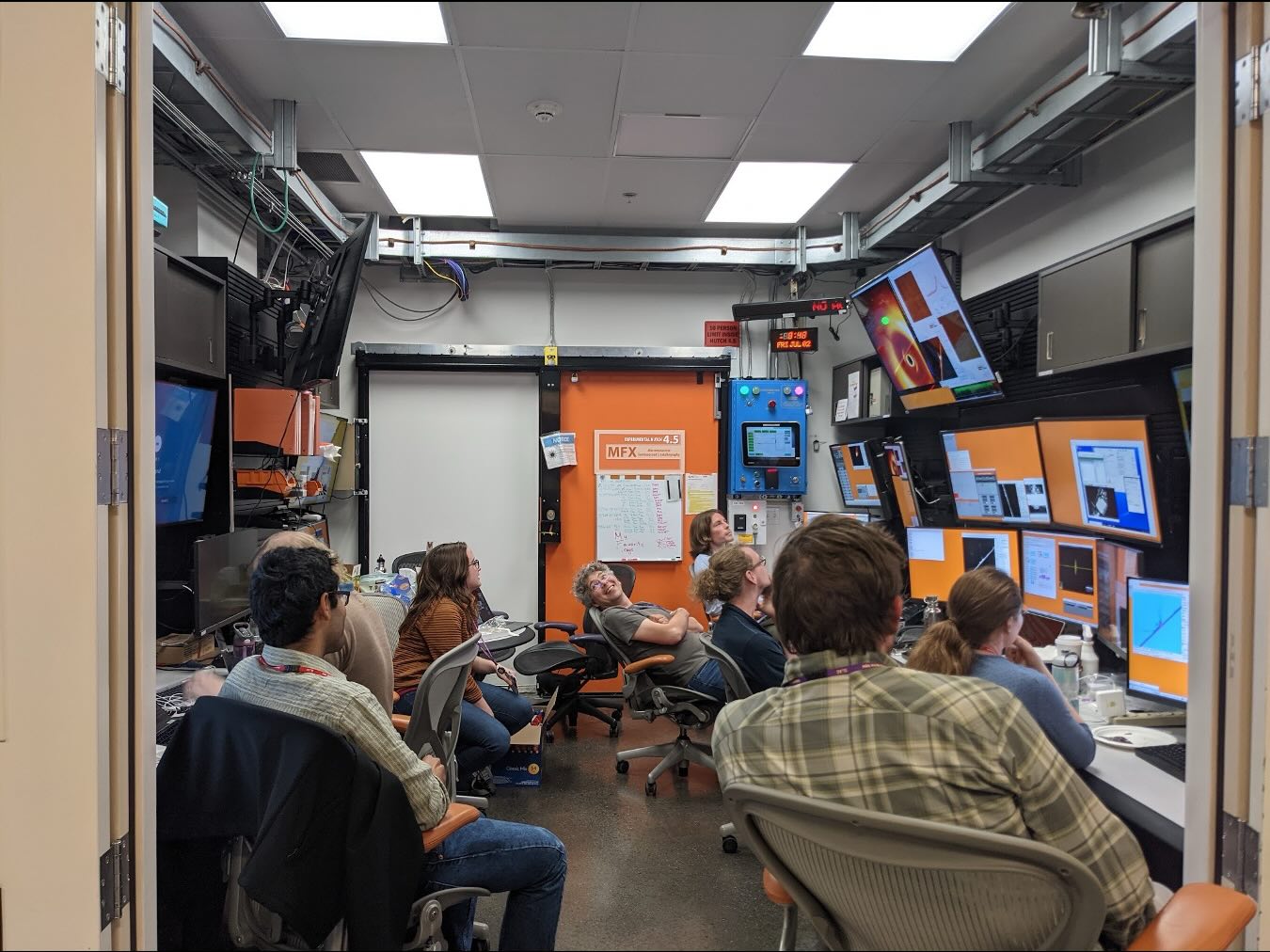
Kern: Both of these studies used the same method in principle. We took a serial femtosecond crystallography (SFX) approach using an X-ray free electron laser (XFEL) to map the atomic structure of the BRCs and PSII in action. What’s special about this technique is that we can study protein samples at room temperature, which is important if you want to study processes that happen at room temperature . . . like Asmit’s water oxidation reaction or my electron transfer processes.
Bhowmick: There’s an ongoing effort here to use XFEL to study these kinds of reactions. We benefited immensely from all the expertise accumulated over the years, both here at Berkeley Lab and from our collaborators elsewhere. Jan and I work in the same group in MBIB, which also includes Aaron Brewster, Nick Sauter, Vittal Yachandra, and Junko Yano. So for some of the experiments we actually did them around the same time and in a similar setup and just changed the conditions slightly. It was helpful to have that collaboration happening in real time.
We benefit a lot from exchanging ideas—how to do the experiments appropriately, how to do the data analysis correctly—and even sharing best practices. Jan’s work and my work explore the smaller parts of the larger photosynthetic process; it’s important to talk and have this collaborative environment so that we can discuss how these things are happening in our different areas and consider the bigger picture.
Biosci Comms: Why are both of these publications important? How do they contribute to the broader efforts of Berkeley Lab and the Department of Energy?
Kern: In this work, we learned how to change the redox properties in the BRC. This means that we better understand how to forcibly alter how electrons move back and forth between chlorophylls. This concept is an important fundamental in photovoltaics or artificial systems where we want to steer electrons specifically in one direction only and avoid the back reaction, which would equal a loss of energy.
Bhowmick: PSII is a great model system for us to study because it gives us an in-depth understanding of a functioning biological catalyst. Now we’re closer to understanding and predicting the mechanisms that control energy production across various scales. Collectively, we’re potentially working toward transferring these principles towards inorganic catalysts and synthetic enzymes. But in order to bring this information to new systems, we need to first understand how these natural systems work.
Kern: These sophisticated natural systems have been optimized by evolution for billions of years… We’re basically just trying to understand and learn their tricks.
This article was updated on October 20, 2026 to add the names of additional co-authors in the Nature Communications publication.


