
Dissolved organic matter (DOM) represents one of the largest and most complex pools of organic carbon on Earth, playing a vital role in regulating the global climate, soil health, and ecosystem stability. Yet despite its fundamental importance to biogeochemical cycles, the detailed molecular composition of most DOM has long remained a mystery, limiting scientists’ ability to link organic matter chemistry to microbial activity and long-term carbon persistence.
In a study published in Nature Biotechnology, Berkeley Lab researchers introduced ENVnet, a global, open-access molecular reference repository created to resolve, catalog, and compare DOM across diverse terrestrial and aquatic environments.
The project was led by co-corresponding authors Trent Northen, Science Deputy for the Biosciences Area’s Environmental Genomics and Systems Biology (EGSB) Division, and Ben Bowen, a staff scientist in Northen’s group. The research united biological expertise with critical contributions from climate and ecosystem scientists Neslihan Taş and Nicholas Bouskill in the Earth and Environmental Sciences Area.
Overcoming Technical Barriers in Environmental Metabolomics
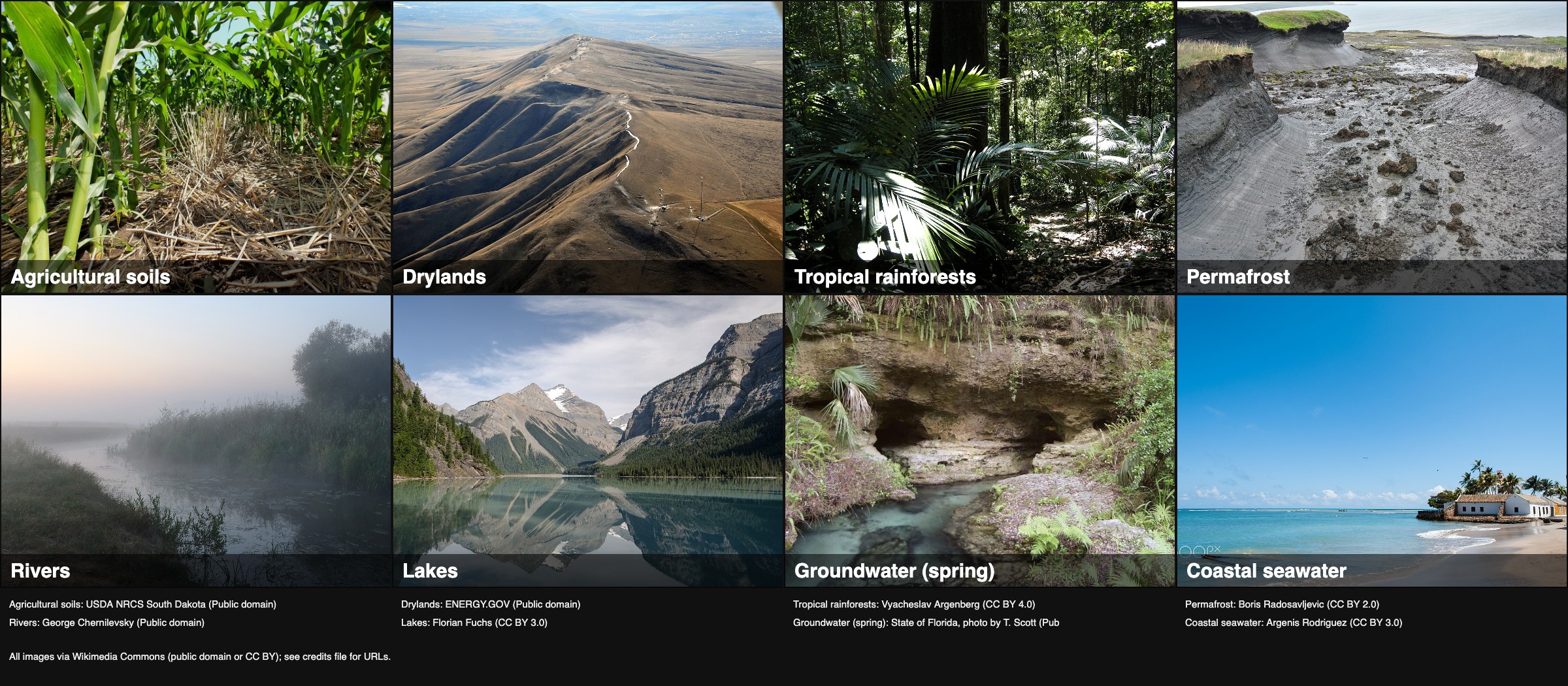
To build ENVnet, the team assembled tandem liquid chromatography-mass spectrometry datasets from 1,389 organic matter samples spanning 13 distinct environment types, including agricultural soils, drylands, tropical rainforests, permafrost, rivers, lakes, groundwater, and coastal seawater. To fill critical gaps in public databases, the researchers directly generated and analyzed 419 new environmental samples under standardized laboratory conditions.
A major barrier in environmental metabolomics has been the prevalence of “chimeric” mass spectra. Because DOM contains thousands of chemically similar compounds, mass spectrometers frequently co-isolate and fragment multiple parent molecules simultaneously, producing mixed signals that prevent accurate compound identification.
To solve this technical bottleneck, the team developed a novel computational deconvolution algorithm that statistically separates mixed fragmentation events into purified, single-molecule spectra without prior knowledge of compound identity. Applying this workflow across 5.6 million spectra revealed that 86% of traditional DOM mass spectra contained co-isolated signals—an important finding for the metabolomics field. The deconvolution method successfully recovered over 22,000 distinct, high-quality molecular features, creating a clean molecular resource for environmental carbon research.
Machine Learning Uncovers Drivers of Carbon Stability
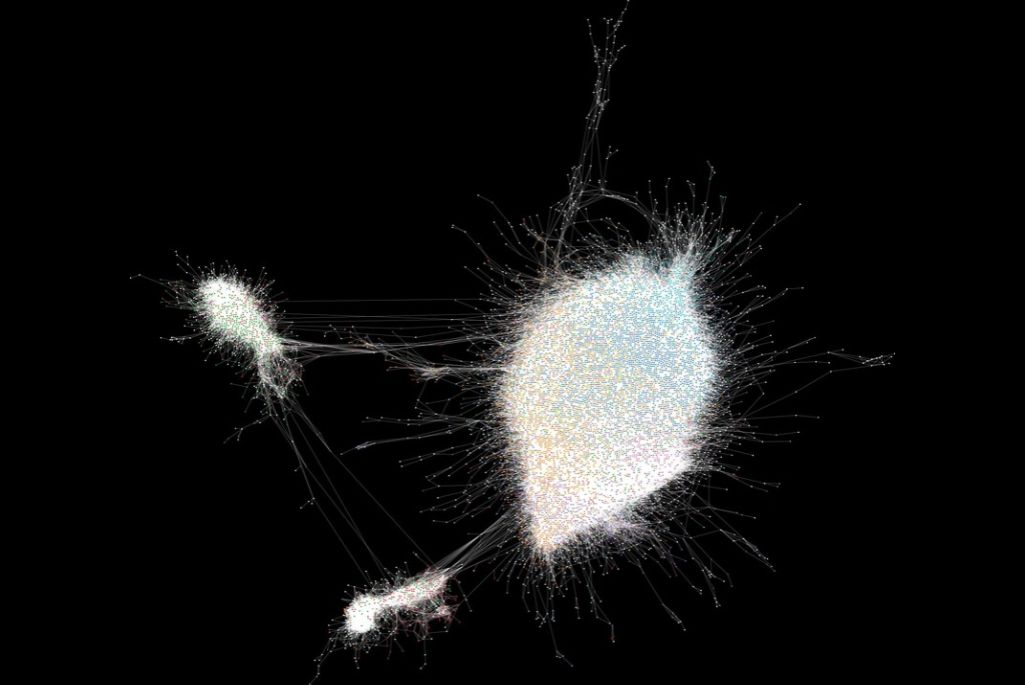
To map chemical relationships across the network, the researchers developed REM-BLINK (Reaction Modification – Blur and Link), a custom spectral similarity algorithm powered by machine learning. By evaluating over 100 chemically meaningful mass differences per spectral pair, REM-BLINK constructed a chemically coherent molecular network of nearly 15,000 interconnected nodes, significantly outperforming traditional cosine similarity metrics.
Using EVNet data from soil incubation experiments, the team trained a machine-learning model to predict carbon persistence, measuring how resistant specific organic molecules are to decomposition by soil microbes. The model demonstrated 91% predictive accuracy, revealing that a molecule’s oxidation state and elemental ratios strongly dictate whether it breaks down rapidly or remains stable in the environment.
Applying this predictive model to ancient permafrost core samples from Alaska (dating back 19,000 and 27,000 years) shed light on a fundamental question in carbon cycling: whether persistent DOM represents untouched residual material or actively transformed compounds over time. The results supported the latter, showing that older permafrost contains higher molecular weight, oxidized “structural neighbors” of known compounds—demonstrating that soil microbes continuously transform organic matter even over geologic timescales at subzero temperatures.
Advancing Strategic Carbon Initiatives
By integrating ENVnet into the freely accessible GNPS2 analysis hub, a web-based mass spectrometry analysis platform, the team provides researchers worldwide with a standardized framework to map their own metabolomic data, compare ecosystem dynamics, and evaluate emerging carbon management technologies.
The initiative directly advances several core strategic priorities for the Biosciences Area, including uncovering molecular foundations for predictive ecology, bridging lab and field observations, and pioneering AI/ML applications for biological systems. The work was supported by key U.S. Department of Energy programs, including ENIGMA, m-CAFEs, RESTOR-C, the Joint Genome Institute, and the National Energy Research Scientific Computing Center.


