
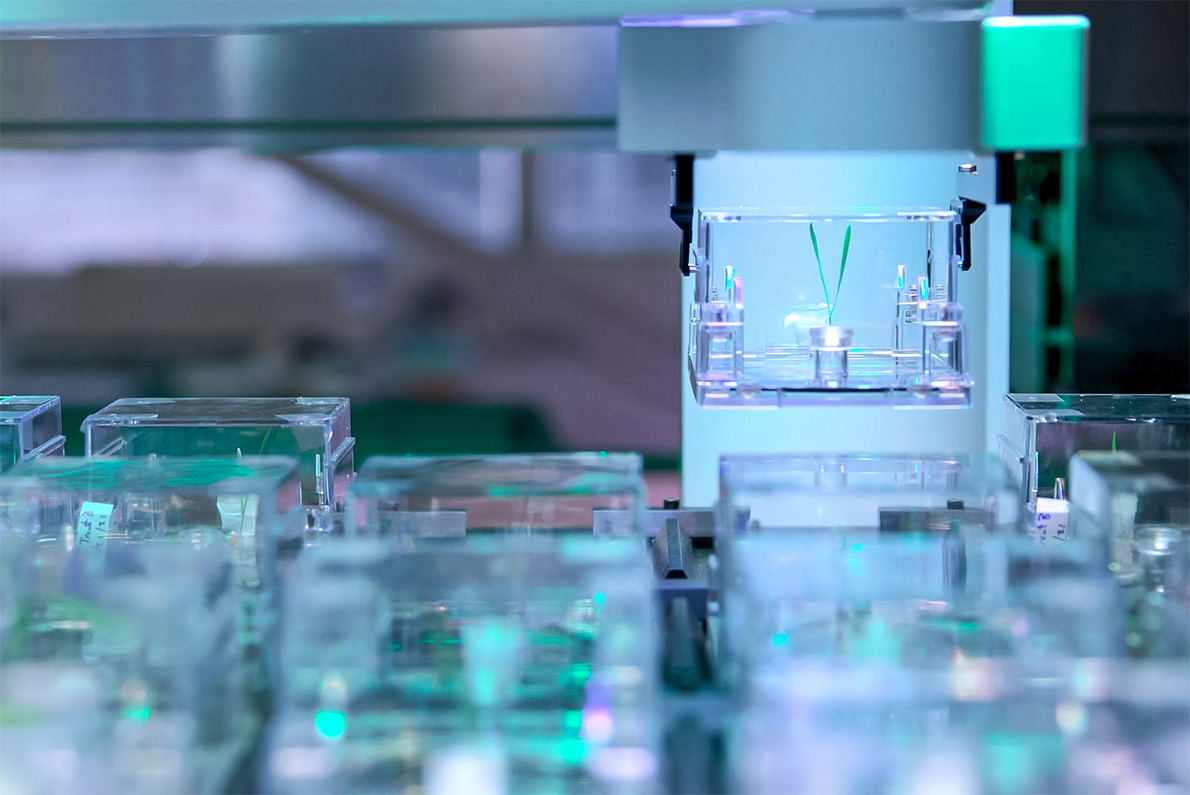
To harness biological systems (plants and microbes) for next-generation energy production and advanced materials, researchers are looking to beneficial plant-microbe interactions. Because these are complex systems, it has proven difficult to reproducibly control exactly which microbes are present. And, subtle differences in materials, methods, or even the hands of the researchers themselves can lead to inconsistent results. This makes it difficult to replicate previous work, significantly slowing the leap from scientific discovery to practical application.
Researchers at Lawrence Berkeley National Laboratory (Berkeley Lab) are overcoming this bottleneck by addressing a multi-layered challenge: building reliable physical hardware, engineering accurate visual sensors, and developing predictive algorithms. Their solution, EcoBOT, stands out from typical plant phenotyping facilities by integrating these distinct components into a reliably automated workflow under strictly sterile conditions.
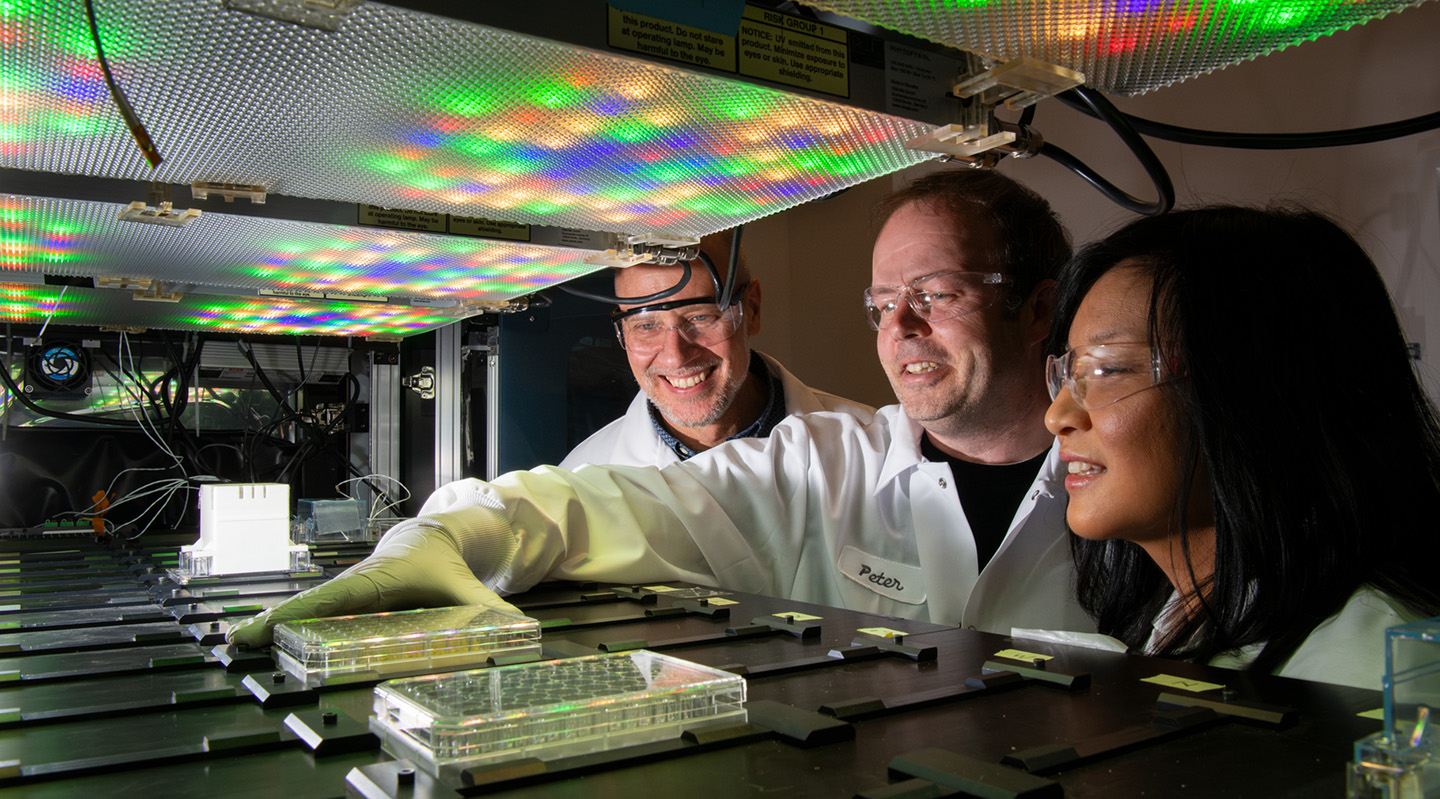
EcoBOT takes specialized growth chambers, called EcoFABs, and integrates them with machine-learning tools that autonomously guide the discovery cycle. This system uses advanced imaging to regularly scan the entire plant—from the tips of its leaves to the bottom of its roots. By using Gaussian Process models and AI analysis tools, it can quickly analyze and model this visual data to calculate the most informative next steps. This directs the automated hardware to determine exactly how plants adapt to environmental stressors, establishing the crucial microbe-free baseline needed to eventually study plant-microbe interactions and engineer better bioenergy crops.
The EcoBOT becomes a true self-driving laboratory through the continuous interaction between its physical infrastructure, sensing systems, and adaptive modeling framework. The robotic hardware stabilizes the experimental environment, the imaging systems convert plant behavior into quantitative measurements, and gpCAM uses those measurements to identify where uncertainty is highest and determine which experiments should be performed next. Using Gaussian-process-based modeling, gpCAM analyzes preliminary experimental results, estimates uncertainty across the experimental landscape, and calculates the next experiments that are likely to be most informative.
By iteratively targeting these knowledge gaps, this autonomous approach improved the predictive accuracy of the plant biomass models by more than thirty percent. Training and processing the complex visual data for these advanced machine learning models requires massive computational power, which the team accesses using supercomputers at the National Energy Research Scientific Computing Center (NERSC).
Berkeley Lab’s culture of team science was essential to realizing this vision. Bringing the self-driving lab to life required a collaboration of plant biologists, robotics engineers, and mathematicians from the Lab’s Center for Advanced Mathematics for Energy Research Applications (CAMERA). These include, from the Biosciences Area: Trent Northen, Environmental Genomics and Systems Biology (EGSB) Division Deputy Director and co-developer of the EcoFAB and EcoBOT systems; EGSB research scientist Peter Andeer, who contributed to the design of EcoFABs and EcoBOT; EGSB staff scientist Benjamin Bowen, EGSB research scientist Vlastimil Novak, Joint Genome Institute (JGI) senior scientist John Vogel; JGI Lab Automation Staff members LT Cornmesser and Joseph Zorzi; and Molecular Biophysics and Integrated Bioimaging (MBIB) staff scientist Peter Zwart, who is the Biosciences Lead for CAMERA. Key collaborators from the Applied Mathematics and Computational Research (AMCR) Division include: staff scientist Marcus Noack, CAMERA Uncertainty Quantification and Autonomous Experimentation Lead and developer of gpCAM; senior faculty scientist and CAMERA Director Jamie Sethian; and senior scientist Daniela Ushizima, CAMERA ML/Computer Vision Lead.
The development of EcoBOT was supported by several DOE Biological and Environmental Research (BER) program projects over the years. It was originally developed by the TEAMS initiative, and is now supported by m-CAFEs, the JGI, and TWINS.
Read more in the Berkeley Lab News Center.


