
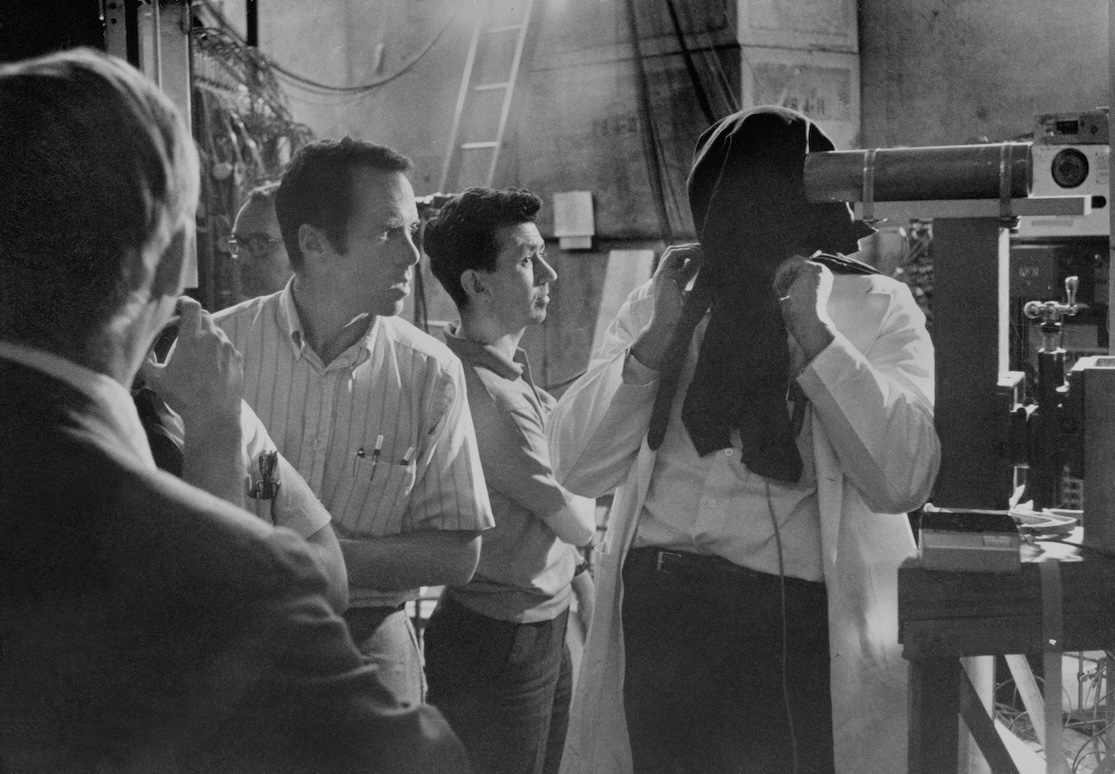
During the Apollo 11 mission, astronauts headed to the moon looked out the window and saw something that puzzled them: little balls of light too small to be stars. They zoomed past, leaving streaks of light as they went. When the astronauts reported the strange phenomena, several theories about its cause were proposed. Some people thought they were lost souls, others thought they were the product of an optical illusion. However, when Cornelius Tobias, a radiobiology researcher at Lawrence Berkeley National Laboratory, heard about the mysterious lights the astronauts had witnessed, he knew exactly what they had seen: charged particles. To prove his theory, Tobias donned a special black hood and exposed his own eyes to a variety of low-dose particle beams. Underneath the hood, Tobias saw the same smattering of light the astronauts had. Eventually, Tobias and his colleagues, John Lyman and Thomas Budinger, determined that the lights the astronauts saw were helium ions and high-energy neutrons colliding with atoms in the eyes. In other words, the astronauts were seeing cosmic rays. This knowledge helped Tobias and other scientists study the effects of cosmic radiation on the body, drastically increasing the safety of future space missions. ⬢
Written by Annie Roth, a science journalist, filmmaker, and children’s author. Research and interviews conducted by Peter Arcuni, a journalist and radio/podcast producer.


