

All life on Earth depends on photosynthesis. The process, carried out by plants, algae, and some types of bacteria, converts sunlight, water, and carbon dioxide into oxygen and chemical energy in the form of glucose. Photosynthesis provides us with food to eat and air to breathe—few chemical processes are as essential to our survival. And yet, scientists still don’t understand exactly how it works.
In 1950, a team of researchers at Lawrence Berkeley National Laboratory that included Melvin Calvin, Andrew Benson, and James Bassham became the first to figure out how plants convert carbon dioxide and hydrogen-carrier compounds into glucose. The series of chemical reactions collectively would become known as the Calvin–Benson–Bassham cycle, or simply the Calvin cycle. This breakthrough earned Calvin the Nobel Prize in Chemistry in 1961 and started an international effort to complete our understanding of photosynthesis.
However, 75 years later, scientists are still trying to figure out the final pieces of the puzzle. These researchers say they are closer to finding these missing pieces than ever before, and doing so could provide humanity with a new, clean and sustainable source of energy.

Nobel Laureate Melvin Calvin in 1961. (Credit: Donald Cooksey/Berkeley Lab)
On August 14, 1945, the Japanese surrendered and World War II came to an end. Ernest Lawrence, a Nobel laureate and researcher at Berkeley Lab (which would later be renamed Lawrence Berkeley National Laboratory in his honor), told a young, up-and-coming researcher named Melvin Calvin that it was “time to do something useful” with carbon-14.
Lawrence had built a groundbreaking new machine, known as the cyclotron, that could produce copious amounts of carbon-14 and other radioactive isotopes. The 34-year-old Calvin, who was working as an instructor at UC Berkeley, saw this as an opportunity to finally solve the riddle of photosynthesis.
At the time, one of the biggest hindrances to understanding photosynthesis was the inability to see what happens to carbon once it’s absorbed by a plant. Calvin theorized that because carbon-14 was radioactive, it could be traced as it travels through a plant, allowing him to see what happens to the carbon atoms absorbed from atmospheric carbon dioxide.
To test his theory, Calvin enlisted the help of fellow UC Berkeley professor Andrew Benson and graduate student James Bassham. Together they created a photosynthesis research group based in the Old Radiation Laboratory that once held the one of Lawrence’s early cyclotrons. To house their experiments, Calvin and his team created what they called the “lollipop apparatus”—a cylindrical glass container surrounded by lights. The team would fill the circular part of the glass container with algae-laden water then slowly introduce carbon-14 into it.
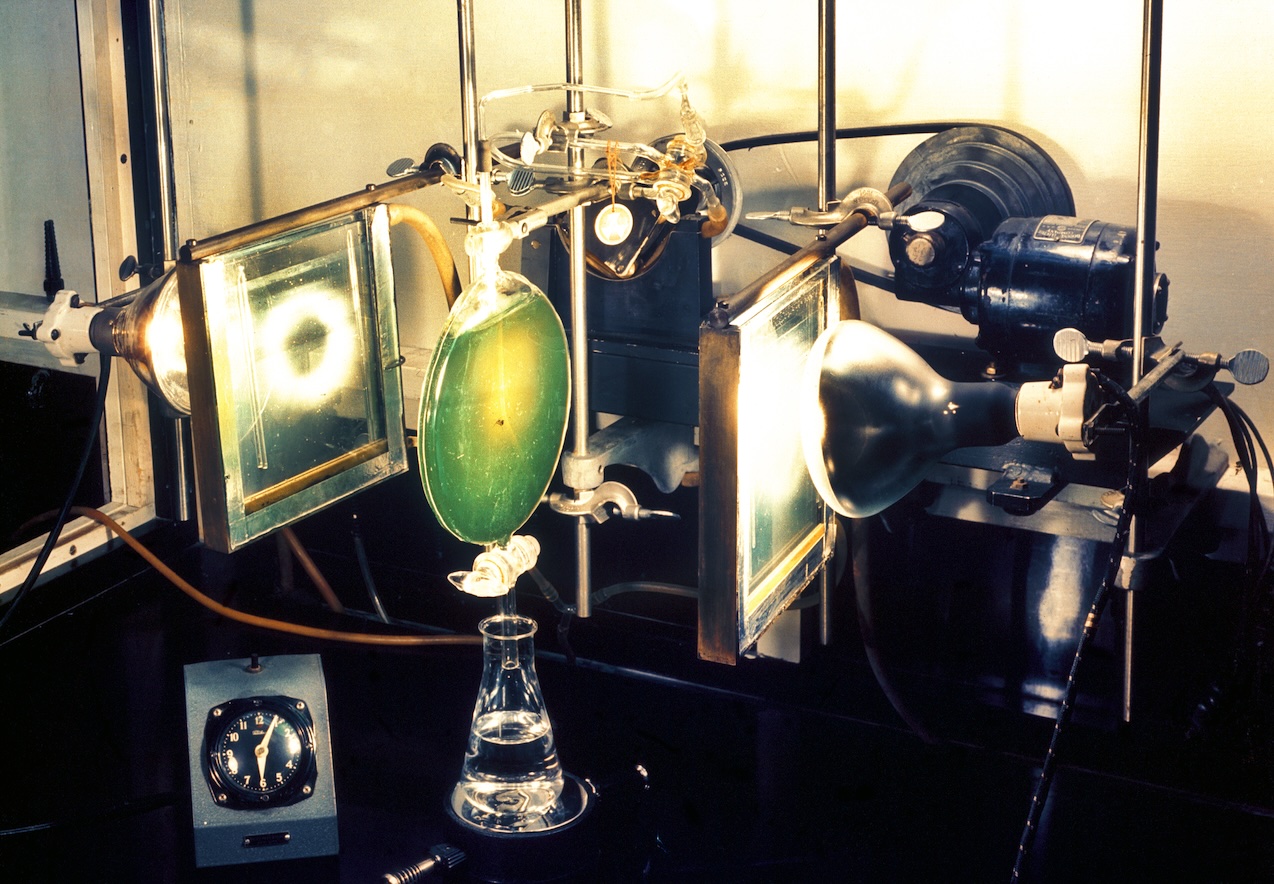
After doing so, the team would periodically sample the algae by sucking it into a tube below the circular part of the apparatus (the stick of the lollipop) where it was immediately killed by a solution of alcohol. The compounds would then be analyzed through chromatography.
“It was the first major application to use carbon-14 radioactive isotope as a tracer for a chemical pathway,” observed Kenneth Sauer in Calvin’s obituary. Sauer, an emeritus professor at UC Berkeley, was a postdoctoral researcher with Calvin at the time he received the Nobel Prize.
A series of experiments, conducted over a period of several years, using the lollipop apparatus resulted in Calvin and his team mapping the path of carbon through a plant during photosynthesis, starting from its absorption as carbon dioxide to its conversion into carbohydrates and other organic compounds. This work also revealed that, rather than acting directly on carbon dioxide, energy from sunlight is first captured by the plant’s green pigment, chlorophyll.
Through their efforts, Calvin and his team mapped the chemical reactions in photosynthesis that convert carbon dioxide and other compounds into glucose, which would eventually become known as the Calvin cycle. This scientific feat revolutionized the world of plant biology and inspired, among other things, the U.S. Department of Energy’s interest in solar energy as a source of power.
“Melvin’s work was the cause of this agency starting its solar photochemical energy conversion research,” remarked Allan Laufer, team leader with the Department of Energy Office of Basic Energy Sciences, in a quote that appeared in multiple obituaries at the time of Calvin’s death in 1997. “He showed [that] converting energy from the sun into useful forms was scientifically possible. He was a very influential man.”
According to those who knew him, much of Calvin’s scientific success can be partially attributed to his lack of patience. “Calvin was probably the most impatient man you ever met,” said Scott Taylor, a retired Berkeley Lab biologist who worked in the Calvin lab as a postdoctoral researcher. “His wife always would flirt with the butcher to try to get good cuts. One day, Calvin was stuck outside the butcher shop and got impatient waiting for her so he started fiddling around with a pencil and paper and figured out the one step in the Calvin cycle that he couldn’t figure out before. He said if it wasn’t for the fact that his wife was always flirting with the butcher, he probably never would have gotten the Calvin cycle down.”
It was also this impatience that drove Calvin to his post-Nobel second act: finding a clean, renewable source of energy. He believed the world was quickly running out of fossil fuels and wanted to provide humanity with a better source of power. According to Taylor, Calvin hated waiting in long lines for gas during the 1973 oil crisis, a time when gasoline was in short supply across the United States. During one particularly long wait, Calvin became convinced that there must be better way to power society than fossil fuels. “That’s when he started thinking about both artificial photosynthesis and also fuels from homegrown plants,” said Taylor.
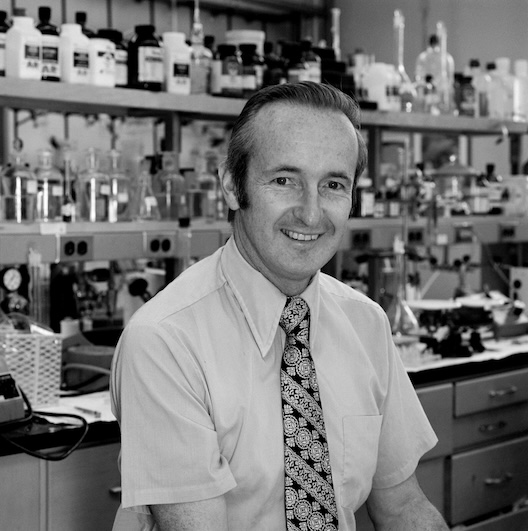
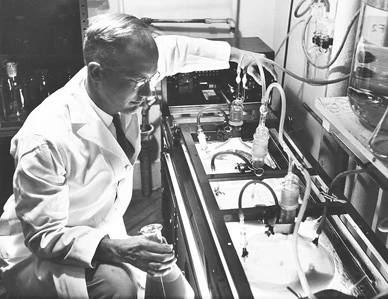
While Calvin set out in search of renewable energy sources, his colleagues Andrew Benson, James Bassham, and the rest of the team behind the Calvin cycle continued studying photosynthesis, using the carbon-14 tracer technology they pioneered.
“At that time, there was a special atmosphere of departure to new horizons in science in Calvin’s laboratory . . . With the excellent equipment in his laboratories and with the then-available new methods of investigation and modern instrumentation, the scientific world was wide open for us,” wrote Hartmut Lichtenthaler, a plant physiologist and former colleague of Calvin, in a journal article honoring Calvin’s legacy.
“After Calvin, there were suddenly tens of thousands of plant biochemists. There weren’t really plant biochemists before him. Plants were studied more as whole organisms, not their individual parts,” said Taylor.
Building on the foundation Calvin and his collaborators created, scientists at Berkeley Lab have long been at “the leading edge of employing these techniques to solve biological structures,” said Heinz Frei, a senior scientist in the Molecular Biophysics and Integrated Bioimaging (MBIB) Division. The rise of genomics, synthetic biology and other fields made possible by new technologies allowed scientists to better understand the inner workings of photosynthesizing organisms. However, 75 years after Calvin’s breakthrough discovery, many pieces of the photosynthesis puzzle still remain.
“Scientists still don’t have a complete understanding of the mechanism of Rubisco, and what the molecular basis is for the trade-offs between selectivity and rate (speed) of the enzyme,” said Frei. “Furthermore, scientists don’t have sufficient understanding of other potential metabolic bottlenecks in the Calvin cycle, and whether or not these bottlenecks are the same for plants and algae or cyanobacteria.”
Scientists at Berkeley Lab, including Junko Yano, Vittal Yachandra, and Jan Kern in MBIB, are currently trying to answer these and other unanswered questions about the enzymes and molecules involved in photosynthesis. One of the most interesting prospects of this research is the possibility of making photosynthesis happen without plants; in other words, artificial photosynthesis. If scientists learn how to harness the power of photosynthesis, they could theoretically build artificial photosynthetic systems that produce clean and renewable energy from sunlight and water.
Over the past few decades, scientists have been able to figure out how many of the proteins, enzymes, and chemical reactions required for photosynthesis work, but there are many aspects of photosynthesis, especially on the molecular level, that have eluded scientific understanding. It is this lack of knowledge that has thus far prevented scientists from being able to replicate photosynthesis artificially.
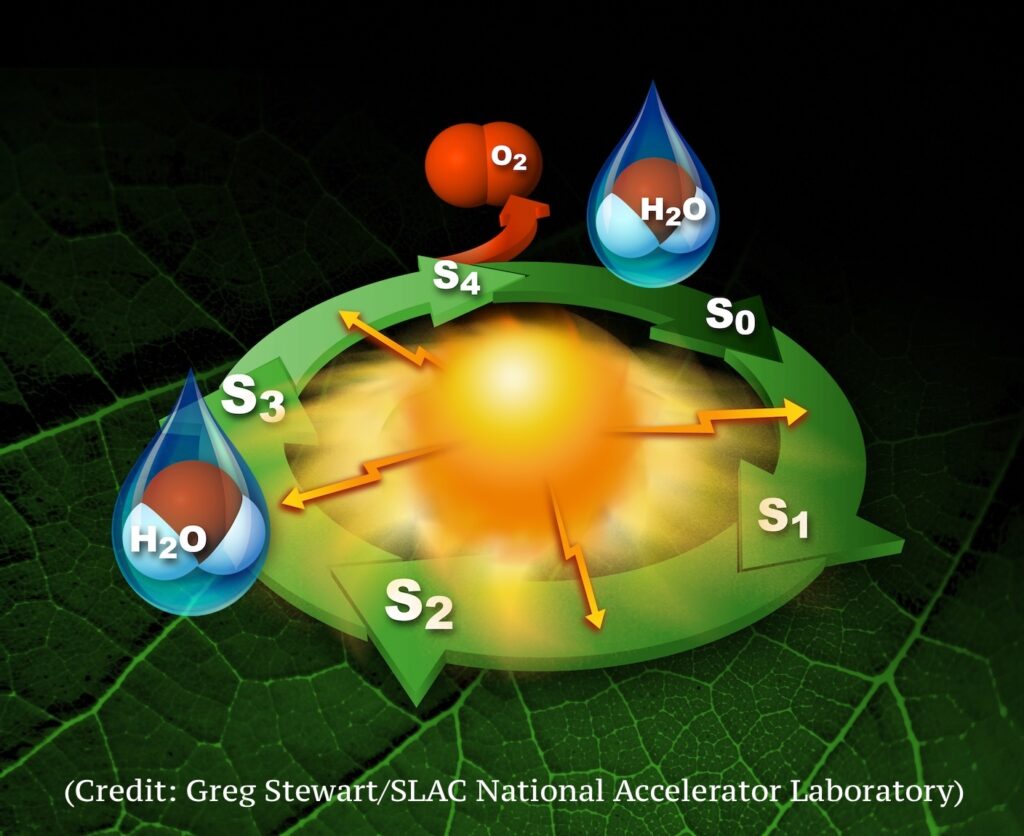
However, in 2020, researchers at UC Berkeley revealed a key step in the molecular mechanism behind the water-splitting reaction of photosynthesis, a discovery that brings artificial photosynthesis one step closer to reality. Yano, who has been studying how water-splitting occurs in photosynthesis for the past 20 years, and her colleagues used nanoscale imaging to observe the enzyme that facilitates the water-splitting reaction of photosynthesis, known as photosystem II, working in greater detail than ever before.
Kok cycle of the water oxidation reaction by Photosystem II
Four sequential photochemical events at the reaction center leads to the extraction of four electrons (oxidation) from the manganese-calcium catalyst resulting in a series transient states (S1-S4), the last of which leads to the spontaneous evolution of oxygen. The Kok clock is reset and the cycle begins again.
“The immediate goal is to make a sort of molecular movie of how this enzyme works,” said Yano. Doing so, she says, will allow scientists to gain a deeper understanding of photosynthesis. “It’s all related to the fundamental question: how do we make an artificial photosynthetic system realized?”
According to those who worked alongside Calvin, the dynamic researcher was gripped by desire to find a renewable source of energy to replace fossil fuels, so it seems fitting that his contributions to science laid the groundwork for the development of artificial photosynthesis. At his peak, Calvin was collaborating with as many as 50 scientists in his laboratory; there are still scientists at Berkeley Lab whose work on artificial photosynthesis was informed and inspired by him.
Calvin would often challenge his students to “think outside of the box,” recalled Taylor. This divergent thinking changed the way scientists study plants and, thanks to the many scientists Calvin mentored, inspired and collaborated with, his legacy lives on today and continues to further our understanding of photosynthesis. ⬢
Written by Annie Roth, a science journalist, filmmaker, and children’s author. Research and interviews conducted by Peter Arcuni, a journalist and radio/podcast producer.
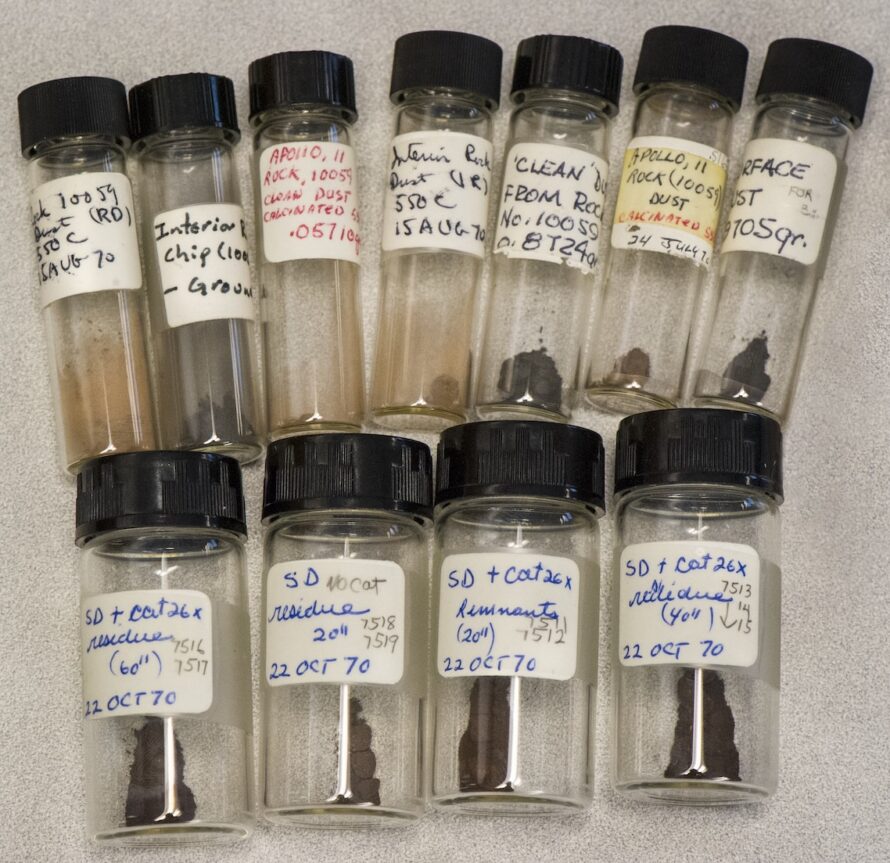
Calvin was among the Berkeley Lab scientists who analyzed rocks and soil samples from the Apollo 11 moon landing in the hopes of finding evidence of extraterrestrial life within them. Rumor has it that a rock or two spent some time on display in his office before finding their way into storage, where they were eventually rediscovered and returned to NASA.


