

Modern life is built on critical minerals and materials. These elements are key ingredients in technologies such as the chips and batteries powering our electronics, the medical devices that diagnose and treat diseases, and the infrastructure of the nation’s power grid, among other things.
Although the U.S. has geological resources of many critical minerals and materials (CMMs), some are only found in challenging forms, either scattered in trace amounts, chemically mixed with other elements, or both. The extraction, separation, and refining processes needed to convert these raw materials into purified products are expensive, complex, and energy intensive.

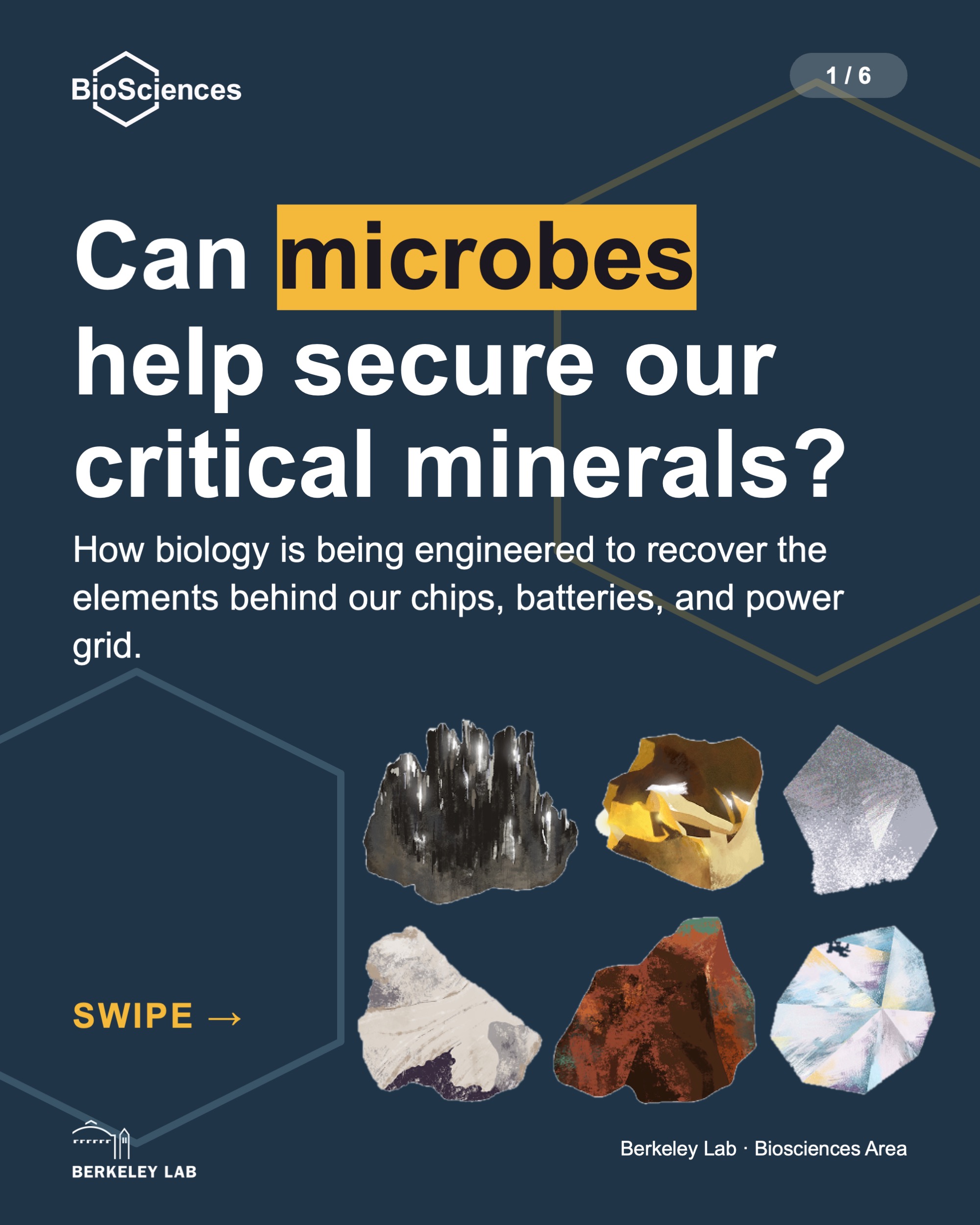


Drawing on expertise in chemistry, Earth sciences, materials science, technoeconomic analysis, artificial intelligence, process scaling, and biology, Berkeley Lab researchers are developing tools and techniques to identify new critical mineral sources and efficiently extract and process elements or recover valuable materials from used products and industrial waste streams.
In the Biosciences Area, a team at the Advanced BioProcess Development Unit (ABPDU) recently began engineering organic molecules and entire microbes to extract critical minerals from liquid waste, such as mining wastewater. The biologists and chemists are using AI tools to speed up the discovery and testing phases.
Another project, from bioscientists at ABPDU, the Joint Genome Institute (JGI), and the Joint BioEnergy Institute (JBEI), seeks to design a microbial process to separate rare-earth elements from dissolved e-waste. The scientists are engineering a microbe to selectively bind these elements from their environment in a bioreactor, and designing processes for efficient separation and purification. This work is funded by the Laboratory Directed Research & Development (LDRD) program.


