
Artificial Intelligence (AI) and automation have the potential to help researchers solve the most pressing challenges in biomanufacturing. By speeding up discovery and providing useful insights and predictions, these tools can help researchers rapidly develop new solutions for producing a wide range of bioproducts.
In order to create a thriving bioeconomy that is driven by these advanced tools, we need platforms that can generate standardized datasets that capture the complexities of biological systems.
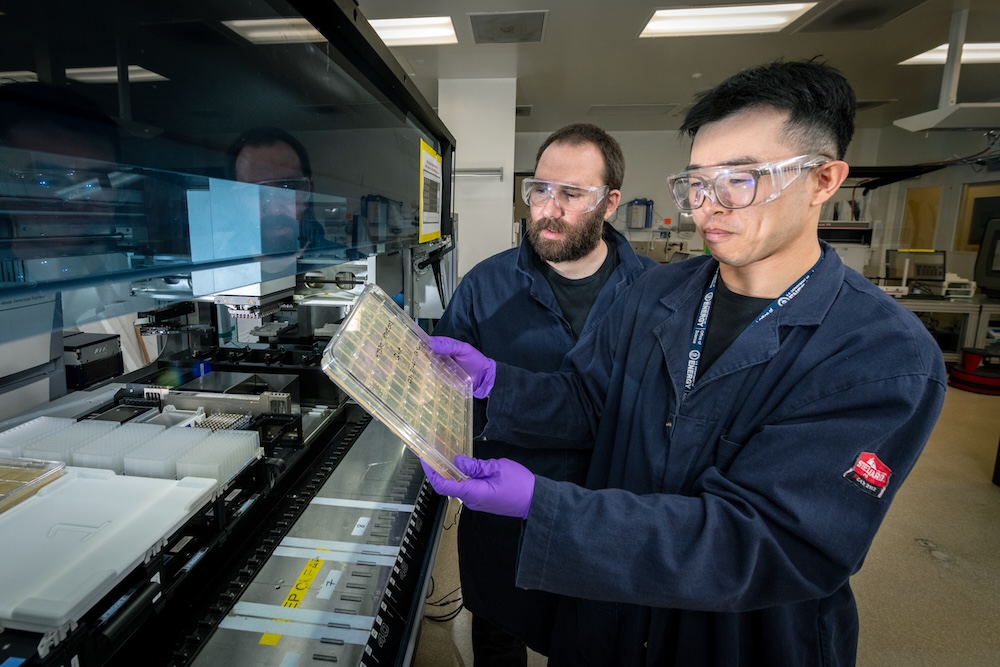
JFAB (JBEI Framework for AI-driven Biomanufacturing) aims to help make this future a reality through its integrated system that connects computational models, automated experimental infrastructure, and an optimized data management ecosystem. This capability will accelerate design-build-test-learn cycles and generate large-scale, high-quality datasets that models need to be effective.
“AI is only as good as the data it learns from, and in biology, high-quality data at scale has been the missing piece,” said Blake Simmons, Director of the Biological Systems and Engineering (BSE) Division and Chief Science & Technology Officer at the Joint BioEnergy Institute. “JFAB closes that gap by linking predictive models directly to automated experiments, turning every design-build-test-learn cycle into training data that makes the next one smarter and faster.”
JFAB is enabled by the Joint BioEnergy Institute, a U.S. Department of Energy (DOE) Bioenergy Research Center.


