
Understanding how something changes over time can require a lot of data. Whether it’s the evolution of an organism or a personal growth curve, taking stock and tracking incremental shifts is important to map change.
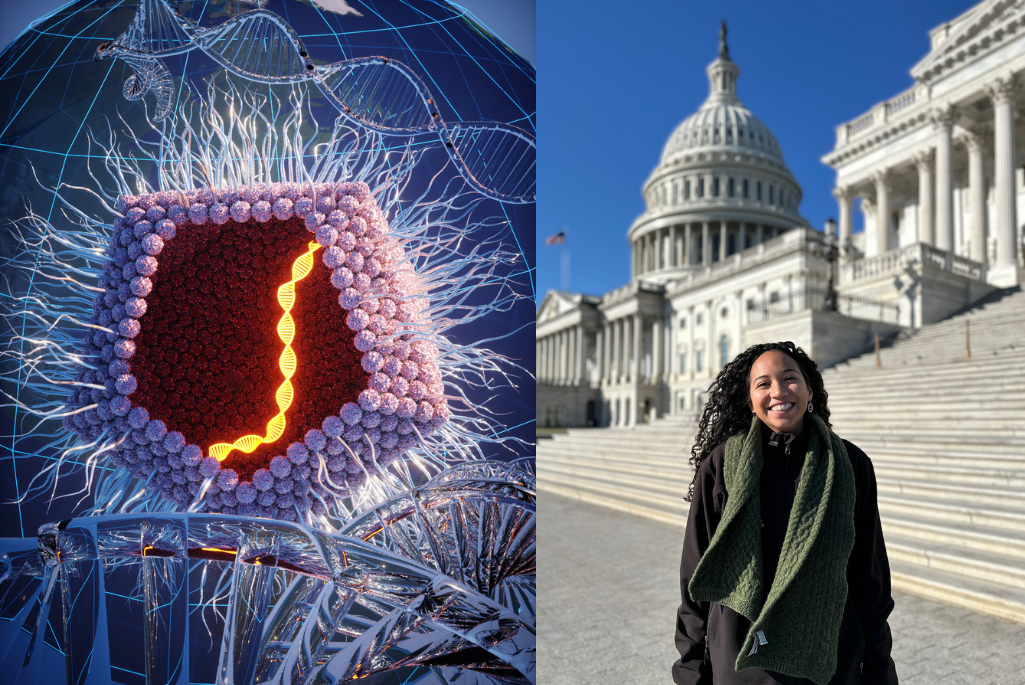
For Yumary Vasquez, a postdoctoral researcher in the Joint Genome Institute (JGI) and first author of a recent article in Nature Communications, analyzing a 20-year time series dataset about freshwater giant viruses was a process that took time, teamwork, and supercomputing strength. Working with JGI colleagues and users, her work revealed the key drivers to genomic adaptation in specific giant viruses and the unnatural introduction of an invasive species which allowed the team to track evolution in real time. And as an alumna of the JGI’s flagship internship program with UC Merced, Vasquez understands that her career path is also an evolution—minus the supercomputers—with this achievement marking the beginning.
Zooming in and out
Giant viruses were discovered only about 20 years ago. While they infect and often hijack hosts like all viruses are known to do, giant viruses are physically and genomically huge by comparison. These behemoths are larger than some bacteria and can be seen with a standard light microscope. And their genomes are giant too—in some cases, 100 times the size of what’s typically associated with a viral genome.
Vasquez and the team of researchers set out to understand how giant viruses in Lake Mendota, a freshwater lake in Wisconsin, responded to environmental changes over time. Approaching a data set filled with genomic data of giant viruses and spanning such a long stretch of time presented quite a challenge for Vasquez as she embarked on this project. “It’s both a gift and a curse to have such a large data set,” she said.
The collaborative effort tapped into publicly-available data from JGI users at the University of Wisconsin-Madison. With JGI colleagues and mentors, Robert Bowers, Tanja Woyke, and Frederik Schulz, Vasquez used tools developed at the JGI and supercomputers at the National Energy Research Scientific Computing Center (NERSC) to sift through the information collected from 2000-2019. NERSC is also a DOE user facility at Berkeley Lab.
She separated and confirmed the genomic information from the giant viruses and then mapped the daily samples to a cumulative data set. This view gave Vasquez a broader sense of the giant viral genomes and how their genes duplicate and transfer, driving change and evolution in this understudied species. “Zooming in and out in the data is how we were able to see the changes happening over time.”
With change comes opportunity
Giant viruses often infect larger hosts, meaning they can have a significant influence on nutrient cycling at an ecosystem level. In the Lake Mendota dataset, the team observed the evolution of giant viruses and their host interactions in real time, when an invasive zooplankton species was introduced to the ecosystem in 2009. As the entire freshwater system changed as a result, so too did the giant viruses — the researchers observed a marked increase in their replication rates while maintaining protective DNA mechanisms, suggesting a viral-like capability coupled with a bacterial-like stability. “We’re seeing evolution happen in real time,” Vasquez said. “It gives us a better view of how things change and teaches us new things about these giant viruses.”
Vasquez began working with genomic data sets as an intern with the JGI in 2022. Then a graduate student at UC Merced, she was paired with JGI mentor Juan C. Villada and they focused on investigating and comparing bacterial genes as a way to predict symbiotic associations. “That was a very different data set, but it was my first chance to really investigate genomes and analyze each gene,” Vasquez said. After completing her graduate studies at UC Merced, Vasquez returned to the JGI as a postdoc researcher, continuing her work with symbiotic microbes.
In 2024, Vasquez joined the group involved in studying giant viruses and enjoyed the new challenges that came along with working with larger data sets. “At the beginning, it was a huge learning curve for me,” she said. “I was really fortunate to have experts and mentors all around me at the JGI.”
Having the Lake Mendota data set has allowed researchers to track how giant virus populations ebb and flow in accordance to the seasonal shifts, and ultimately, adapting to changes in the lake microbiome. Similarly, Vasquez’s contributions to both giant viral research and the next generation of scientists at the JGI continues to evolve. In 2025, she was a mentor for a UC Merced graduate student through the same internship program she completed, where their work focused on developing an AI agent for giant virus data research. “We worked on a research that was recently accepted for publication,” she said. “As an intern who’s now a mentor, it’s a nice, full-circle type of moment.”
Learn more about educational partnerships and outreach on the JGI website.


