
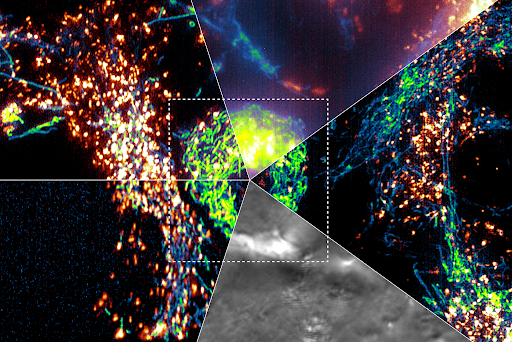
Biology doesn’t happen at one scale. Molecular interactions unfold in milliseconds and nanometers, while disease-associated change such as in Alzheimer’s, can spread across millimeters of brain tissue. Understanding complex biological systems requires scientists to watch both — ideally at the same time and with the same sample. Historically, this has meant shuttling samples between specialized instruments, often damaging biological context and slowing results. There’s also a common crux across microscopes: the closer you look at living tissue, the more the image blurs, and the more detail you capture, the more overwhelming the resulting data become.
Srigokul “Gokul” Upadhyayula, a faculty scientist in the Molecular Biophysics and Integrated Bioimaging (MBIB) Division worked with collaborating institutions to develop the Multimodal Optical Scope with Adaptive Imaging Correction (MOSAIC) — a reconfigurable microscope that consolidates more than ten imaging techniques into one compact instrument. It processes its massive datasets using computational tools developed with funding from a Laboratory Directed Research and Development (LDRD) award and supported by the Perlmutter supercomputer at the National Energy Research Scientific Computing Center (NERSC).
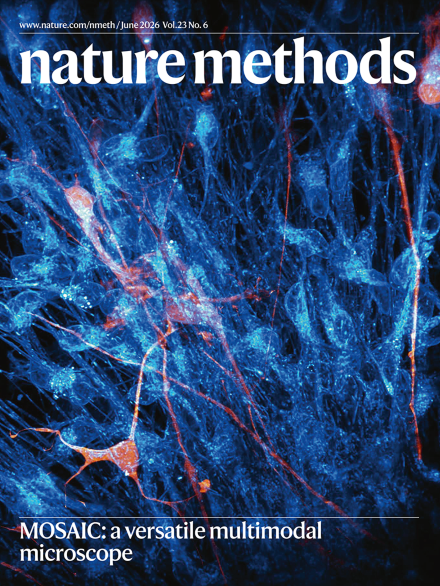
Featured on the cover of Nature Methods, MOSAIC allows scientists to track biological processes across scales and compare imaging methods on the same sample. It generates data at a pace that is pushing the boundaries of what biology can discover.
“ The recurring problem is no longer our ability to acquire the data,” said Upadhyayula. “These microscopes can generate massive datasets at staggering rates. The key bottleneck is turning dense five-dimensional observations into biological understanding.”
What comes next, Upadhyayula believes, could be transformative: a vision language model that reasons natively over biology, connecting what it sees with molecular identity, experimental context, and prior biological knowledge to determine which observations matter and which experiments should come next.
“Connected to automated microscopes, sample handling, and perturbation systems, that capability could provide the foundation for self-driving biological laboratories — and fundamentally change the rate at which we can make discoveries,” said Upadhyayula.
Read the press release in the Berkeley Lab News Center.


