
Huntington’s disease (HD) is a fatal, inherited neurodegenerative condition. People with Huntington’s have a mutated copy of a protein-coding gene that contains many extra nucleotides in a repeating sequence. The exact functions of this protein, called huntingtin, are unknown; but in individuals with the HD mutation, neurons in certain regions of the brain begin to die in adulthood, leading to cognitive and physical decline and eventual death.
Previous research has revealed that over the course of a patient’s life, the mutated gene gains even more of these repeats due to errors that occur during cell division. The more repeats someone has, the earlier the disease onset and more severe the symptoms. Until now, it was unclear how the mutation, the subsequent mutant protein, and ongoing mutational repeat expansion over a patient’s lifetime lead to neurodegeneration.
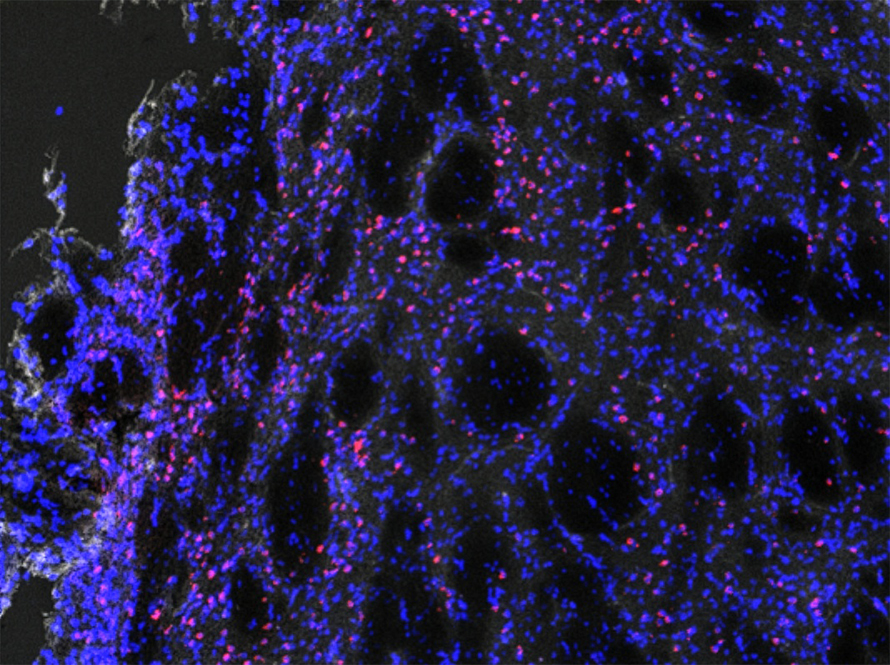
Biosciences Area researchers Aris Polyzos, a biochemist research scientist, and Cynthia McMurray, a retiree affiliate, both in the Molecular Biophysics and Integrated Bioimaging (MBIB) division co-led research that was recently published in Nature Communications. The work, in collaboration with colleagues from Berkeley Lab and the Harvard T.H. Chan School of Public Health, revealed an additional, previously overlooked characteristic of HD—a marked increase in breaks in DNA strands across the genome—that is linked to neurodegeneration. They then demonstrated that treatment with an antioxidant that suppresses these breaks could rescue mice from neuron damage and symptoms of the disease.
“We’re excited to add another piece to the puzzle for this disease, which has proven to be frustratingly complex for a condition caused by a single gene mutation,” said Polyzos.
Scientists around the world are now curious to see what happens when antioxidants are administered to real patients. The first step is to establish that the same disease mechanism that was curable in the mouse also occurs in humans. Polyzos is leading a study using induced pluripotent stem cells taken from HD patients, which will be coaxed to differentiate into neurons. The team can use these to confirm the disease-induced DNA breakage results in neuronal death in a human context, and further investigate how the disease suppresses DNA repair.
“I believe we’re opening the door to a new way to treat Huntington’s patients,” said McMurray. “Past approaches have tried to edit the gene, shorten the repeats, or block the gene’s expression; those are complicated interventions and none of them have translated into efficacy for real patients. The question is, will ours work in humans? The next step is to show that our findings apply to human cells and that we can protect neurons, which would be a precursor leading to clinical trials.”


