
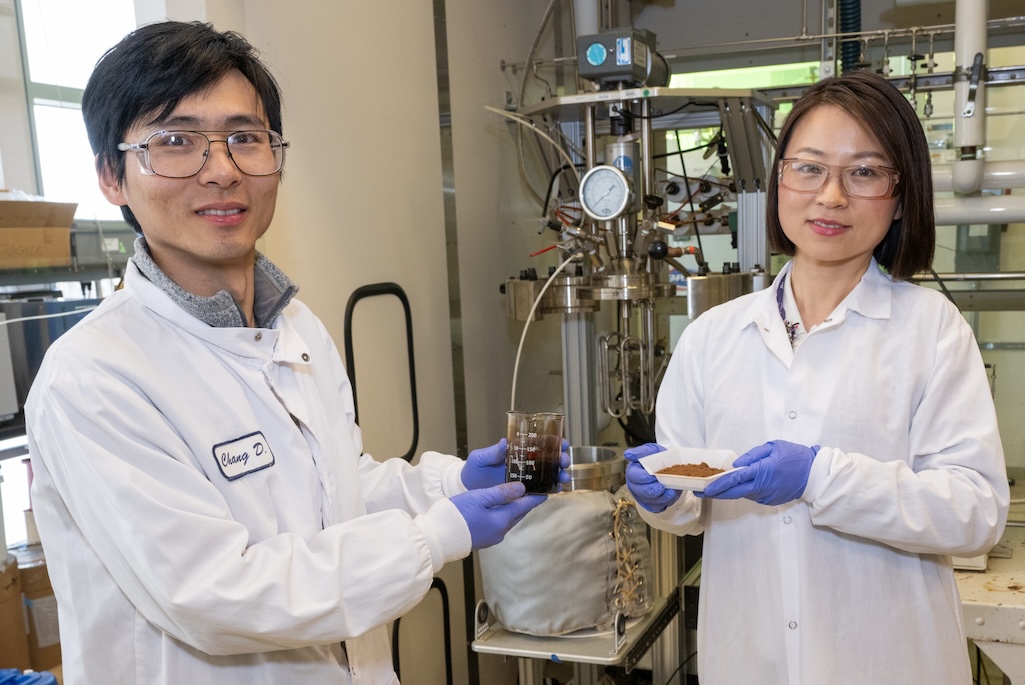
The pulp and paper industry, which manufactures everything from tissue paper to cardboard, also generates a significant yet often overlooked byproduct — a complex polymer called lignin. Around 100 million tons of lignin are produced each year. Despite being the largest natural source of aromatic carbon on the planet, most of it ends up burned for energy. This is due to its complex structure, which is notoriously difficult to process. Researchers are exploring ways to leverage industrial lignin by developing methods to convert it into useful bio-based chemicals.
A new study led by researchers at the Department of Energy’s Lawrence Berkeley National Laboratory (Berkeley Lab) established a scalable process for converting one of the toughest types of lignin, called kraft lignin, into benzylamines — a valuable chemical used in the production of pharmaceutical ingredients, dyes, fertilizers, and pesticides.
Benzylamines are typically made from a chemical that is highly toxic. Producing them from lignin provides a unique, more environmentally friendly alternative — while also making use of this cheap, abundantly available resource that often goes to waste.
“Recently, there has been interest in converting lignin into benzylamines,” said Chang Dou, the lead author of the study and a principal scientific engineering associate in the Biological Systems and Engineering (BSE) Division and at Berkeley Lab’s Advanced BioProcess Development Unit (ABPDU), a scale-up facility that enables innovative biotechnologies to advance from the lab to commercial relevance. “We gained a better understanding of how lignin reacts to different solvents, and the process we developed can be applied to different types of lignin.”


