
For researchers wanting to capture snapshots of molecules in action, it’s all about the angles. Small-angle X-ray scattering (SAXS) is a technique used to study molecules on the nanoscale while they’re suspended in fluid. It works by blasting an X-ray beam through the liquid and measuring the angle of the scattered X-rays as they bounce off the molecules being studied.
Unlike X-ray crystallography, another technique used to study molecular structures, SAXS doesn’t require the molecule of interest to first be meticulously coaxed into a crystalline form. Instead, researchers can study the molecule while it’s in a fluid state, which allows the natural shape to be seen as it moves, bending and folding while it interacts with other molecules in the solution. Understanding how a molecule moves and responds to something else can help inform a wide range of applications—from accelerating the design of enzymes for biofuels to enabling the rapid analysis of therapeutic and disease-related proteins.
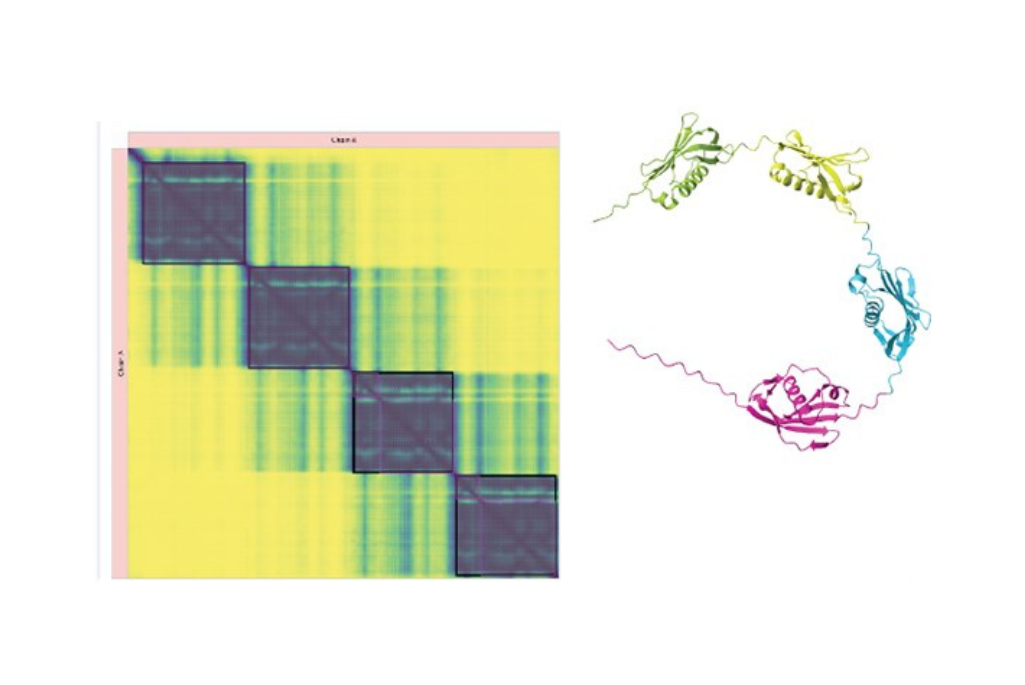
A team of researchers including Michal Hammel, a staff scientist in the Molecular Biophysics and Integrated Bioimaging (MBIB) Division, and Scott Classen, a computational research scientist also in MBIB, have built a web-accessible computational platform that uses SAXS structural information, supercomputing power, and AI to help scientists model dynamic protein structures faster than before. The platform, named BilboMD, was recently described in an article published in Nucleic Acids Research. BilboMD offers an accelerated and more democratized approach to analyzing SAXS data while laying the groundwork for future experiments that merge structural data with AI-driven prediction tools.
“We built BilboMD so that any scientist can use it. They can plug in their data and instead of waiting hours, they can get predictive results in less than an hour.”
– Michal Hammel
BilboMD is a culmination of over 20 years of research. It combines experimental data collected from SAXS experiments on the SIBYLS beamline at the Advanced Light Source and AI-predicted protein structures from AlphaFold and other tools like RoseTTAFold to form realistic models of how proteins actually move and behave. To test the platform’s accuracy, the team applied other, more time-intensive, techniques that involved fluorescent labelling to confirm the structural shapes and measuring the molecular weights of the predictions made by BilboMD.
The platform runs on the National Energy Research Scientific Computing Center (NERSC) supercomputer, enabling researchers everywhere to access and leverage the tool, receiving results and experimental feedback in near real time. The number of new users is increasing each week and case studies by collaborators at Oak Ridge National Laboratory and independent users continue to affirm the Berkeley Lab team’s findings. “We built BilboMD so that any scientist can use it,” Hammel said. “They can plug in their data and instead of waiting hours, they can get predictive results in less than an hour.” It’s publicly available for anyone to access through the web portal or download as standalone software through GitHub.
The team is now aiming to expand the type of molecules that BilboMD can recognize while also considering how to more deeply connect the tool to data infrastructure platforms like the National Microbiome Data Collaborative (NMDC) and DOE Systems Biology Knowledgebase (KBase) to further enable community-driven structural data portals and self-driving labs. “The flexibility of these proteins has often been overlooked by traditional computational models until now,” Hammel said. “We still have a lot to learn, but with this tool and AI, we’re getting closer to faster results.”


