
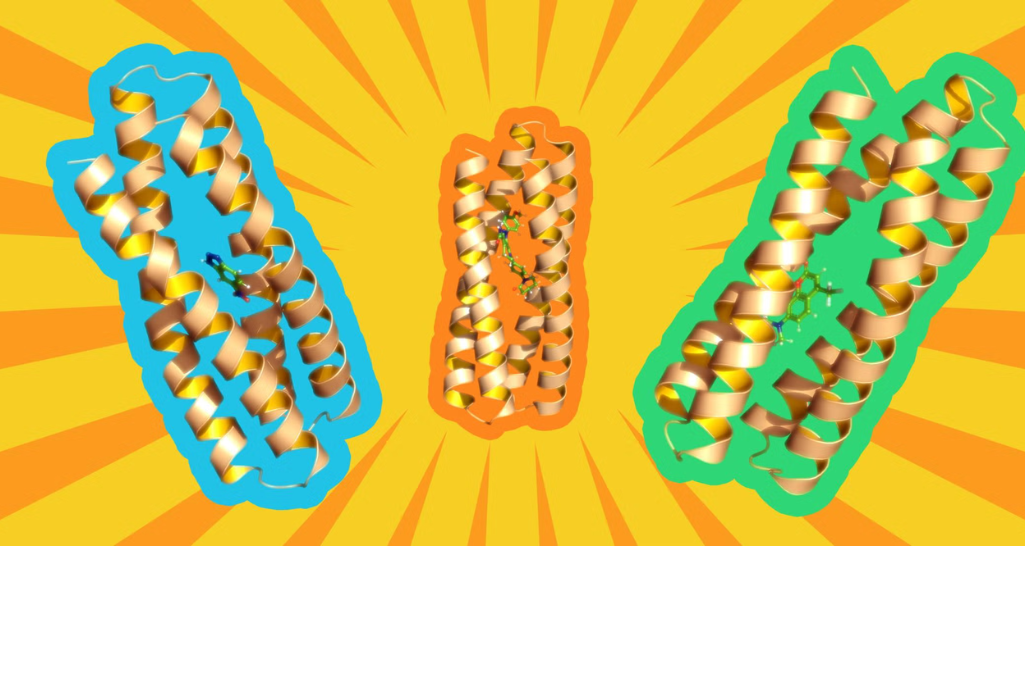
Proteins are among the building blocks of life. Comprised of amino acids, they control or influence all living processes—from those taking place in the human body to the chemical reactions in our environment. Understanding and leveraging enzymes, or proteins that catalyze particular reactions, has the potential to impact a variety of applications in biomanufacturing, environmental remediation, and energy solutions.
A team of researchers co-led by James Fraser, a faculty scientist in the Molecular Biophysics and Integrated Bioimaging (MBIB) Division and a professor at University of California San Francisco (UCSF), and William DeGrado, also a professor at UCSF, developed a new way to design proteins with specific functionality. The approach, published recently in Nature Chemistry, utilizes the unique and enigmatic ways in which proteins interact with surrounding molecules. This method led the team, which included collaborators from UCSF and SLAC National Accelerator Laboratory, to produce two novel proteins with entirely different functions—one of which is the most active designed enzyme to date.
“The bigger implications of designing proteins more efficiently are really exciting,” said Fraser. “But right now, the challenges of defining where and how to make proteins more efficient catalysts has been limiting.”
To explore ways to increase the efficiency of proteins, researchers combined a protein known to bind to a blood-thinning drug called apixaban-binding helical bundle (ABLE) with small molecule fragments. Fraser and collaborators used Beamline 8.3.1 at the Advanced Light Source (ALS), accessed through ALS-ENABLE, to observe how the proteins behaved in these circumstances and study their interactions.
They found that the proteins responded “promiscuously,” meaning they interacted weakly with multiple partners or catalyzed multiple reactions beyond the known primary function. Researchers combined these insights with AI models and a known method used to design proteins, called directed evolution, to guide the development of two proteins with new functions. One of these, fluorescent ABLE (FABLE), lights up and can be used as a biosensor; the other, Kemp eliminase ABLE (KABLE), is 10 times more active than any other enzyme of this type designed to date.
“This work suggests that incorporating synchrotron radiation earlier in the protein design process is worth pursuing,” Fraser said. “It opens up new possibilities for solutions that are broader and now, potentially more efficient, than ever before.”
MBIB affiliate scientist Galen J. Correy was a co-first author on this study.


