
Read full article on the EESA website.
Many people take a probiotic to promote gut health, but what they’re consuming is technically called a simplified synthetic microbial community (SynCom): a curated group of microbes designed to help with a specific function. As microbes are important in many settings outside of human health, SynComs are used in numerous different ways–especially in environmental contexts, in which microbes are crucial to helping plants survive stressors like flooding, extreme temperatures, and drought.
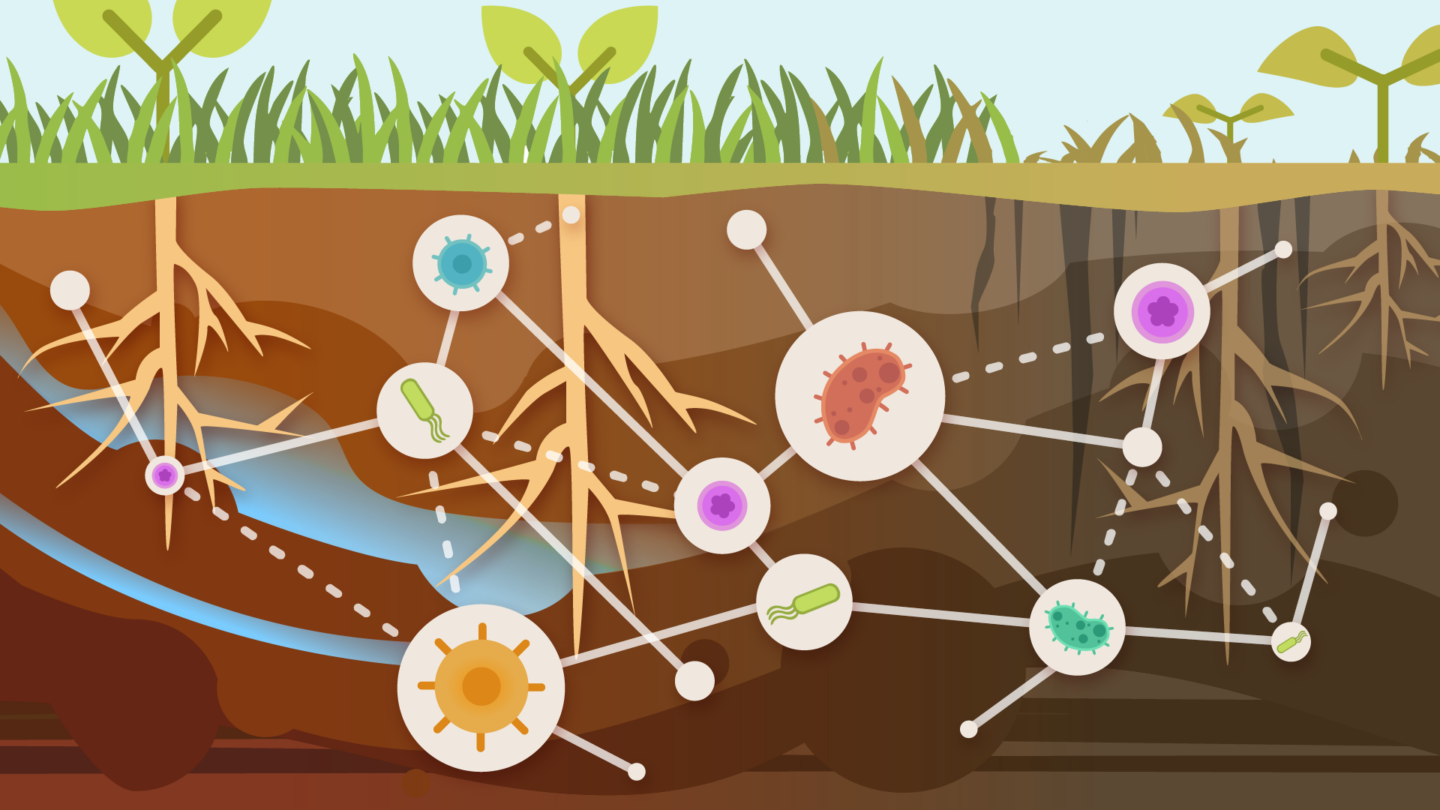
Scientists found that a SynCom composed specifically of microbes from the rhizosphere–the region of soil composed of plant roots and their associated microbes–can help plants better recover from drought. Their results, recently published in Frontiers in Microbiology, demonstrate the importance of rhizosphere microbes in helping plants recover after disturbances. This could bring us one step closer to a potential future where, to facilitate the growth of more resilient plants and crops, we swap out chemical fertilizers for helpful bacteria.
“The rhizosphere environment is pretty complex,” explained Earth and Environmental Sciences Area (EESA) Postdoc Mingfei Chen, who led the study in Romy Chakraborty’s lab as part of the Microbial Community Analysis & Functional Evaluation in Soils Scientific Focus Area, m-CAFEs SFA. Chakraborty also carries a secondary appointee position in the Environmental Genomics and Systems Biology (EGSB) group. “There are thousands of different kinds of microbes in the rhizosphere. Many of them are really helpful to plants, but others not so much. This study shows that isolating and increasing the concentration of microbes that directly benefit plants can help us optimize plant stress tolerance.”


